By Sara Belmore
Edited by Kristina Tham and Anna Roberts
In the late eighteenth and early nineteenth centuries, a new, impressionable market emerged: children. Ilaria Ampollini describes a new “sensitivity towards children, which led to the recognition of childhood as a space in the world in its own right” (40). The recognition of children’s market power and their susceptibility to external influences caused an influx in commercial items, including those that could assert societal values and ideals to shape a child’s worldview from an early age. Books, toys, puzzles, and games strategically became an efficient way to make learning enjoyable and enticing while reinforcing ideas about class, gender, race, and behaviour in children. This essay explores how The Game of Life is a pedagogical tool meant to enforce a timeline upon children and perpetuate a single, ‘proper’ way to live one’s life: namely, an upper-class, academic, family-focused, problem-free life. With its chance-based play, unavoidable checkpoints, and biased messaging through rules and visuals, The Game of Life encourages an unattainable, unrealistic ideal that promotes the American Dream. The game assumes a targeted audience as children are exposed to materialist, consumerist, capitalistic, classist, and heteronormative tendencies through the structures of the game, imposing upon children a single way of viewing and living life. Through the game’s modifications, the restricted capitalist mindset becomes inherent to the pedagogical messaging, promoting a narrow view of progress and success necessary to build future productive members of society.
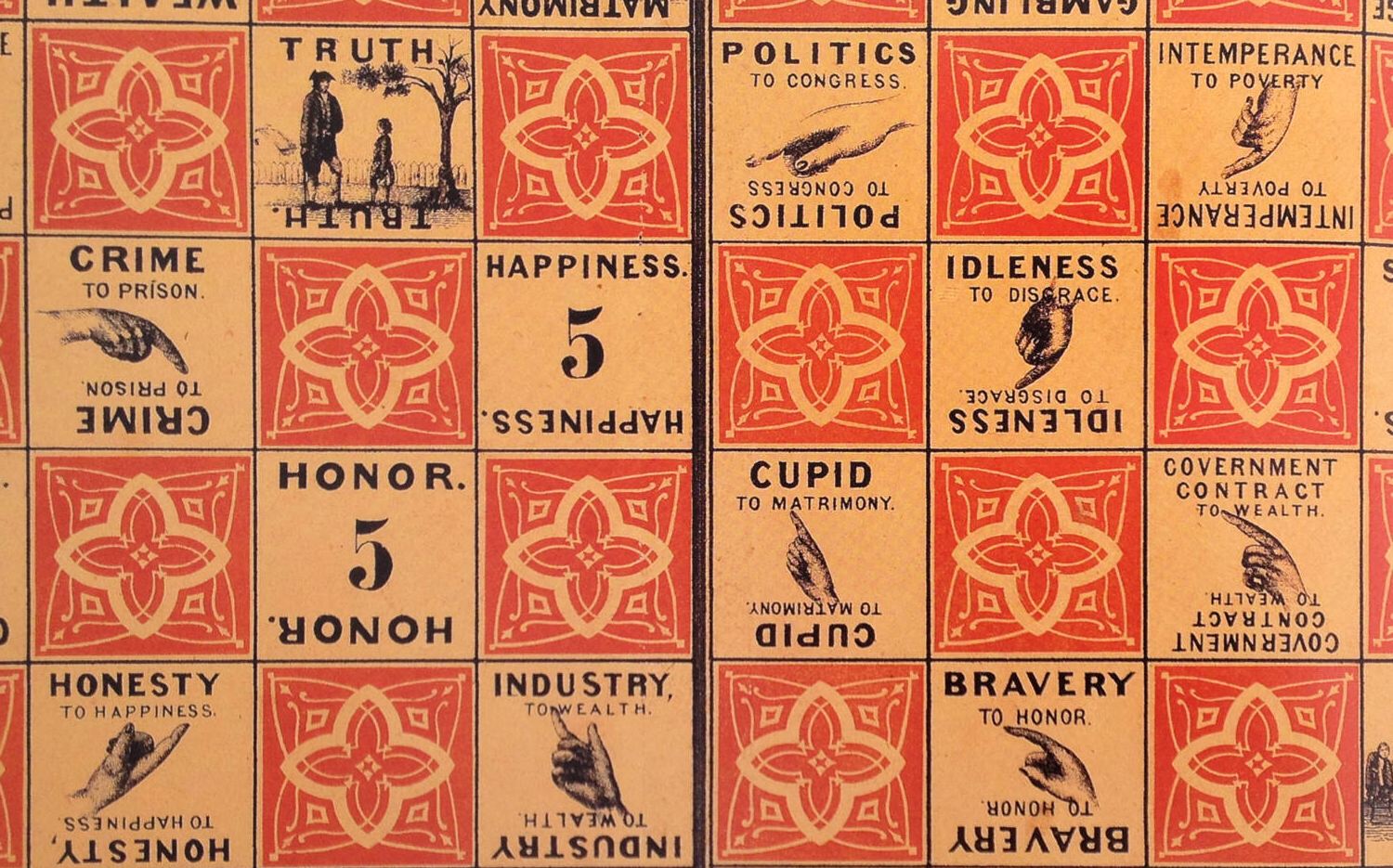
The Game of Life was created with the intention of influencing young minds by drawing a select series of possible outcomes to simulate the chance experience of life. Milton Bradley founded his eponymous company—later merging to become part of Hasbro Games—in 1860 after his creation of The Checkered Game of Life (Lepore xvi; xv). After finding success in his version of checkers, Bradley restructured the game into the acclaimed Mansion of Happiness (or Mansion of Bliss) where he claimed that “life is a game…[and the] board is your map” (xxii). The cyclical game—derived from a genus of Southeast Asian “square board race games,” dating back thousands of years (xvii)—involved players following the predestined path and celebrated “evolution” as well as “progression” above all as the key to the pursuit of happiness (xi). As delineated by American historian Jill Lepore, the “Social Game,” a game based on interaction and the exploration of social networks, was created with the intent to “forcibly impress upon the minds of youth the great moral principles of vice and virtue” (Bradley qtd. on xvii). The game essentially reinvented the “pursuit of happiness…as a lesson in consumer conformity, a two-dimensional Levittown, complete with paychecks and retirement homes and medical bills” (xvi). Lepore illustrates the proliferation of Bradley’s game in the United States, and its impact on the games industry, especially in the 1960s after the Industrial Revolution, when the driving factors of the game emerged:the rise of mass consumerism and an age of progress (40). Children were recognized as an influential market of productive members of society who could further America’s steadily growing capitalist goals. Teaching children that stability and success come from affluence, the ideals of consumption and ownership proliferate not only this game but many similar games, such as Monopoly, and become the pedagogical foundation within the gaming experience.
After having gone through significant updates over the years, The Game of Life continues to assume a certain audience and lifestyle, impressing this upon young players who take the opportunity to stand in their parents’ shoes and pretend to be an adult for a few hours. The original game was much more vulgar and explicit as the winding road began at an “Infancy” square and always ended on the “Happy Old Age” square—unless one’s character judgement led them to the chance possibility of ending the game with “Suicide.” While older versions are a rich artifact to dissect, this essay discusses the development into one of the most popular and successful versions of The Game of Life from the early 2000’s. When Hasbro bought Bradley’s company in 1984, the game was revised a few years later and adapted so that the previous market of baby boomers could pass the experience down to their children (Lepore xvi). Lepore accurately describes the game’s modernization: “in an attempt to botox the shiny, puffy nowness of youth into a gray-whiskered game, Hasbro decided to start again… the station wagons swelled into minivans and it became possible…to have a midlife crisis” (xvi). New versions of the game were released, including one for “adults”–––ages twelve and older––called The Game of Life: Quarter Life Crisis. The game’s classic glossy, multicoloured, maximalist board is enticing to all ages, and allows for an escape from one’s life’s problems into another life’s problems; however, the problems on the board differ greatly from those of real life and sugarcoat adulthood with what are considered ‘life’s biggest stressors.’ These stressors appear on yellow squares detailing a “Snowboarding accident! Pay $5,000,” or “Job relocation. Pay $20,000,” and, as such, the messaging in this game assumes an upper-class character who can not only afford to go snowboarding on the weekends, but whose most prominent issue in life is a subsequent accident. With predetermined challenges, the game denies the intersection of problems that are specific to marginal identities, ignoring challenges related to disability, or racial and gender discrepancies. The game therefore claims that there is no space for such differences within the American Dream and ‘others’ anyone who does not conform to the standard that the game promotes. The one-dimensional game disregards systemic inequality and diverse life experiences while setting an unrealistic standard for children to strive for in their own lives, regardless of their individual social identity.
While the modernization of the game led to a less dichotomous view of the world, adding more nuance and detail than in the Mansion of Happiness, the recognition of children as a market led the game to become a commodification of life that further reflects the increasing idolization of a capitalist society. As Jennifer Snyder—a Bradley scholar—states, “Bradley didn’t believe in dice” as they were “associated with gambling,” which was “bad” (Edwards). The gamemaker instead developed the classic rainbow spinner at the centre of the board, as if the players are not explicitly gambling with their money and their ‘lives’ throughout the game. Children are primed for the most strenuous, painful parts of life by simply choosing a new career card from the deck when they lose their job, continuously accruing an income that prepares them for the next obstacle where they might be told to “Redecorate your home. Pay $80,000,” or “Buy lakeside cabin. Pay $120,000.” Further restricting the path and choices for children, the career cards limit the imagined possibilities and equalize the work that it takes to obtain a career such as “Professional Athlete” or “Lawyer.” The game even categorizes the options as “Careers” and “Starter (or College) Career,” claiming that one must continue to advance and work towards bettering their life which is only possible through a higher paying job. The game targets a certain class of players, and creates unrealistic expectations that determine wealth as the sole factor to achieve happiness or success in life.
As the game’s main goal is having the highest sum of money by the time a player retires, The Game of Life idolizes and exemplifies the 21st century notion of ‘hustle culture’ and ‘grindset’ that requires constant productivity. Merriam Webster defines ‘grindset’ as “a mindset fanatical about grinding, or extreme striving towards one’s goals… [and] ‘working assiduously,’” to assume maximum wealth and status—a concept that was prevalent among the baby boomer generation (“Grindset”). In the game, every task, event, or square involves making or spending money. The game continues to further align with the capitalistic ideals of the twenty-first century by teaching children how to become productive members of society, but only from within a certain class range—a tax bracket that can afford to inconsequentially spend $65,000 on a “Maid and Butler Service.” Children themselves are presented as assets and dictate the amount of money one can spend or receive. One square delineates that the player must pay $5,000 per child to go to a sports camp; aspects of the game such as this one assume a certain demographic—one in which children have access to leisurely activities and the financial ability to attend. Children, in The Game of Life, become measurements for wealth. The game ends, not when a player dies, as in Mansion of Happiness, but when all players retire to either Countryside Acres or Millionaire Mansion and win a sum of money, descending in order of retirement. When a player is at the societally designated age that they are deemed no longer able to contribute to society, their life is over as they no longer have a job; this concept advances the idea that one’s sole purpose in life, and measurement of value, is in their productivity as an economic subject. Players win money based on their assets—including the amount of children they have—making the game about what Lepore describes as “an accounting of income and expenses,” rather than “a battle of virtue and vice” where you “count your cash, not your good deeds” (xxx). According to the National Association of Home Builders, 77% of U.S households can’t afford a medium priced home, let alone pay $50,000 to “Have a family website designed”––something The Game of Life implies is a norm (“Nearly Half…”). Bradley’s invention promotes a standard of the American Dream and allows children to escape into an idealized fantasy where on any average day they might “Win [the] Nobel Prize [and] collect $100,000.”
In this version of life, there is no option for poverty, diversity, or idleness and therefore children are less likely to imagine alternative future life paths or goals. Orange tiles on the board contain large red “STOP” signs and force players to go to school or choose a career, to get a starter or upgrade their home, and, unavoidably, to get married. The game considers the STOP squares as major life events and insinuates that they are inevitable and necessary for a successful, happy, fulfilling life. A few of the STOP squares are forks in the winding path of life and imply a sense of choice in the game of chance. Players can choose, for example, the “Family Path,” where there is higher possibility to have more children, or the “Risky Path,” where there are more gambling opportunities with stakes in winning or losing money, or, alternatively, they can “Continue on the Path of Life,” as if it is entirely separate. The concept of ‘choice’ implies that life stops, or is entirely consumed, when you choose to start a family or go back to school.
Society teaches children that there is a proper timeline to follow with mandatory life milestones at certain ages—lessons that are heavily perpetuated through The Game of Life. In Jack Halberstam’s book, In a Queer Time and Place, he argues that “queer uses of time and space develop… in opposition to the institutions of family, heterosexuality, and reproduction” (1). Halberstam explains that queer people often do not align with temporal markers for conventional timelines. Halberstam’s model thus employs “queer” as a verb to challenge or disrupt convention, effectively queering one’s timeline; however, any queering of this predetermined way of living would not align with the capitalist grindset as efficiency would not be a priority. If children began to understand that their mental, physical, and emotional health should be prioritized, there would be less working citizens and the models that allow capitalism to thrive would be quickly deconstructed. Through this game, and other similar methods of pedagogy, children are taught that there are certain life goals and events that determine success and when they do not choose to meet, or cannot meet these goals, there will be repercussions. Through the lens of Katherine Bond Stockton’s work, The Queer Child, or Growing Sideways in the Twentieth Century, Safa Jaffe elucidates the concept of “chrononormativity” as the sole, distinctive way of understanding a person’s growth over the course of their life due to its predictable and linear nature. The winding road on the board perpetuates the concept of chrononormativity as there is no option to alter the course, skip temporal roadblocks, or move non–linearly. On the road, one must remain on a single path within a car with four seats for children, implying an inevitable next step in life: creating a family. Even the character pegs impose heteronormative and chrononormative ideas as a player can only choose between pink and blue pegs. A 2021 version of The Game of Life was the first to change the colours of the pegs to imply inclusion and diversity instead of demonstrating the gender binary—another standard that limits a child’s understanding of the multitudinous possibilities in life apart from social ideals. The pink and blue pegs do not only connote gender, but they reject association with race—a factor that is extremely prevalent in and indicative of the challenges one faces in their life. The modification of Bradley’s original game to adopt vehicles reflects societal advancement, and also represents the constant forward motion of life as characters are trapped in cars that cannot turn around or restart—they must persevere. The Game of Life instead claims a specific version of success and denies the possibility of living a nonnormative life; there is only one road for the pursuit of happiness. In this game, one cannot manipulate their path; the only place that a second chance is offered is at the “Return to School” STOP square, where the rules explain that “[y]ou’ll be more likely to get a better paying job,” again reinforcing the idea that money is at the centre of every decision made in life.
Moving into the technological age, games have evolved to include and adapt to the rise of technology, making it inextricable from daily life as it contributes to the promotion of efficiency which furthers the capitalist grindset. Many games have moved away from the idea of a “finish line,” and instead consistently perpetuate the never-ending cycle, and mindset, of progress. In another recent version of the game, The Game of Life: Twists and Turns, the game can continue forever, furthering the concept of unceasing work, denying idleness because it does not facilitate progress. Twists and Turns reimagines life through the involvement of a Visa-brand electric spinner and credit cards in Milton Bradley’s name. Even if the game’s original driving pedagogical force was its ability to teach children how to budget and spend wisely, the recent versions have eliminated this factor through a “battery powered mechanical deity” that does not show how much money each player has until the end (Lepore xxxi). The technological addition removes the physical value of wealth as children no longer take on the role of the banker where they would learn by directly dealing with physical bills. As Lepore outlines, a Visa spokesperson justifies the change from paper to plastic: “[w]e are not marketing to kids. We are helping to educate kids. It’s never too early.” However, in removing the physical aspect of dealing with money, children have no agency over their in-game finances. The new version of the game thus eliminates the educational aspect of controlling one’s assets—the money is mysteriously added and subtracted by the all-powerful machine. Lepore also delineates that in the 1990s, a team of designers on Wall Street were tasked with updating the game to focus less on money, but “gave up” as the structure no longer made sense. The designers’ inability to eliminate dependence on money solidifies the fact that The Game of Life revolves around the balance in your bank account, not your experiences; children, mini-games, colourful bills, cars, and cards are all just “distraction[s]” (xxx). The game revolves around wealth as the sole measure of success. As Twists and Turns can be played for any amount of time, you can continue to play even while in debt. No one dies or grows older and therefore this version creates the possibility for an endless cycle of vying for wealth. The message Twists and Turns promotes is one aligning with the ‘more is more’ mindset, where growth is not tied to one’s personal achievements and successes, but is instead tied to one’s amount of assets and the number on the Visa-spinner’s screen.
In using The Game of Life as a pedagogical tool, children are not only taught how to be an adult and lead what is seen as a ‘stable’ life, but they are also taught that there is only one kind of adult to be—one way to live life. Bradley’s belief in the importance of children’s education was his reason for creating the game, but when he “lost interest,” the gamemaker “devoted his energies…to the nascent kindergarten movement” (Lepore xxxii). Bradley’s capitalistic, binaristic, heteronormative game does not align with his original plan to offer free education to “poor” children. The game promotes unrealistic expectations and caters to an upper-class audience—an assumption that provides a large market, but inconsiderately excludes diverse life experiences. If children are meant to learn from The Game of Life, their takeaways will include a lack of perspective, a misunderstanding of identity markers, and an adoption of a capital-focused mindset. The game promotes a misleading vision of life where children learn to expect an easy path with few roadbumps, ignorant to individual experiences and challenges that arise from race, class, and gender variables. Thus, the inclusion of diverse characters who do not conform to gender norms, racialized characters, people of alternative classes, or even the opportunity for more choice in the game is essential. During developmental years, when children are heavily influenced by their environment and begin to form their beliefs based on their surroundings, representation within pedagogical materials is crucial. While it may be argued that children are too young to face the true challenges of daily life in the twenty-first century, it is unwise to assume that teaching how to swipe a Visa card rather than using paper cash is any more productive. Ultimately, the message being perpetuated by The Game of Life is one that forces children into a specific mindset in which they believe there is only one path to success—along the linear, restrictive, yellow brick path of life.
Works Cited
Ampollini, Ilaria. “Scientific Knowledge and Educational Board Games: From Domestic Experiments to Popular Science.” Centaurus, Brepols Publishers, January 2024, https://doi.org/10.1484/J.CNT.5.142124.
Edwards, Phil. “Why the Game of Life Used to Have Poverty, Suicide, and Ruin.” Vox, 13, Jan. 2020, https://www.vox.com/2015/1/28/7924487/game-of-life-history.
“Grindset.” Merriam Webster, updated 23 Jan. 2025, https://www.merriam-webster.com/slang/grindset.
Halberstam, Jack. In a Queer Time and Place: Transgender Bodies, Subcultural Lives. New York University Press, 2005.
Jaffe, Sara. “Queer Time: The Alternative to ‘Adulting.’” JSTOR Daily, 10 January 2018, https://daily.jstor.org/queer-time-the-alternative-to-adulting/.
Lepore, Jill. The Mansion of Happiness: A History of Life and Death. Knopf Doubleday Publishing Group, 5 June 2012. “Nearly Half of U.S. Households Can’t Afford a $250,000 Home.” National Association of Home Builders, 17 May 2024, https://www.nahb.org/blog/2024/05/housing-affordability-pyramid.
Feature Photo
Bruce Whitehill’s copy in Paris, Board game Studies Colloquium XIII, April 2010.