By Olivia Cordeiro
Edited by Olivia Wigod and Anna Roberts
In the years following the Civil War, white Southerners yearned for the social and economic prosperity of the antebellum period. Plantation nostalgia was ever-present in society, as George Washington Cable depicts in Old Creole Days. Cable outlines a series of characters who long for the period when plantations dominated the economy, framing these plantations as romantic settings. However, in the same period, Black Southerners fervently rejected the idealization of plantation life. They sought to reveal the truth about the atrocities suffered at the hands of slave owners. Charles Chesnutt’s The Conjure Woman subverts the romanticization of the plantation setting by focusing on stories about the realities that Black people faced during this time. Both Cable and Chesnutt utilize frame narratives, which take on the “story within a story” structure. By having an initial story that shifts to centre on a different narrative, the authors produce layered senses of didacticism, both within the inner frame and in the larger context of the book. Cable casts Black voices to the periphery to uplift the concerns of white characters. Inversely, Chesnutt dilutes the blaringly ignorant white voices by having a Black character intervene to tell a larger tale of the suffering endured on the plantation that the white Northerners forcefully occupied. Chestnutt’s frame narrative in The Conjure Woman subverts Cable’s frame narrative in Old Creole Days by deromanticizing the plantation setting and bringing forth the voices of enslaved people.
Cable’s stories belong to a larger body of literature that is defined by an idealized recollection of the antebellum period. Following the Civil War, those on the side of the Confederacy felt slighted by the illegalization of slavery, and therefore developed a sense of nostalgia for the time when white Southerners held significant dominance over the social and economic spheres. There was often a direct link between the contemplative pastoral and economic production, with the ties between social and economic realities forming an incredibly intertwined relationship (Glazer et al. 5). This relationship meant that the rampant racism towards Black people that was present in the South during slavery only worsened after independence; white Southerners blamed Black people for the downfall of the economy, which further enabled the social stratification. In the period after the civil war, there was an ideological echo chamber within these Southern states. With no knowledge of how to rectify their economic stagnation, and no clear path upon which to direct their anger, the only comfort they found was nostalgia (Glazer et al. 5). This nostalgia manifested in a chivalric way: the era of plantations became increasingly associated with a life of leisure, valiant men, soft-spoken women, and most importantly, aristocracy (Glazer et al. 6). The antebellum era was entwined with facets of medieval romance and courtly love. For Southerners, the idea that one person could have overarching power over another was a sign of wealth and prosperity; when this was taken away, they longed for this power once more. Southerners reimagined the plantation as a picturesque setting—a place where white Southerners could live in leisure while displaying their aristocratic status.
The notion of the plantation as a romantic setting lingers in Cable’s writing, where he describes it as an idyllic environment conducive to stories of love. Cable’s outer frame begins with a narrator wandering the streets of New Orleans, dictating the beauty of the city for the readers; he begins at “Canal street, the central avenue of the city, and to that the corner where the flower women sit […] and make the air sweet with their fragrant merchandise” and turns onto, “the quiet, narrow way, which a lover of Creole antiquity, in fondness for a romantic past, is still prone to call the Rue Royale” (Cable 1). The opening lines of this story depict an idealistic New Orleans—a New Orleans untouched by war. Cable draws the reader into what is framed as a beautiful romance, yet he hints that this is not a realistic representation, as the “lover of Creole antiquity” is longing for something that is no longer there: the Rue Royale. The lover is reminiscing on a history structured by royalty and hierarchy, emphasizing the chivalric notion of the “romantic past.” His longing is corroborated when the narrator turns around to witness the “architectural decrepitude, where an ancient and foreign seeming domestic life” has taken over the once-picturesque city (Cable 20). The city is no longer beautiful; there are no flower women, Creole antiquity crumbled, and the sense of domesticity disappeared. The emphasis on this visualized life being “domestic and foreign” grounds the narrator’s idealization in a past that is no longer active. In this passage, the inner frame of the story begins to unfold, as Cable represents the destruction of a once gorgeous setting as the direct result of the freedom of Black people. It is in this desolate view of New Orleans that the narrator stumbles into the home of a woman he once knew, Madame Delphine, which launches him into the inside of the frame narrative.
Madame Delphine’s story epitomizes the plantation romance, highlighting the idealization of the South before the secession. Madame Delphine’s daughter Olive is mixed race, but “you would never believe she was [Madame Delphine’s] daughter, she is white and beautiful” (Cable 33). Cable establishes Olive’s beauty as conditional; she is beautiful so long as people believe that she is white. If people discovered that Olive was Madame Delphine’s daughter, they would no longer perceive Olive as beautiful. Olive first appears in this story veiled; “her head and neck were scrupulously concealed by a heavy veil, and her hands, which were small, by gloves” (Cable 25). The story follows Madame Delphine as she tries to find Olive a husband. Olive physically hides her identity, an action that she and Madame Delphine believe is essential in order for Olive to marry. This veiling demonstrates how Cable’s romance story is only accessible to white people. Through the explicit exclusion of Black people from the romantic narrative, Cable is asserting that his idealized tale is exclusive to white individuals. There is one suitor in particular whom Olive is determined to marry: Capitaine Lemaitre. Capitaine Lemaitre represents the quintessential high-ranking man of the French aristocracy in post-Civil War New Orleans; he is “a pure-blooded French Creole” defined by “the fineness of his hair and the blueness of his eyes” (Cable 9). Capitaine Lemaitre’s physical description directly contrasts Madame Delphine’s; while he encapsulates the ideal French white man, Cable describes Madame Delphine as “a small sad-faced woman, of pleasing features, but dark and faded” (Cable 24). Madame Delphine and Capitaine Lemaitre represent two different worlds within New Orleans, as seen by the narrator in the outer frame. Madame Delphine’s Blackness masks her beauty, while Olive’s perceived whiteness ensures her own freedom, and Madame Delphine is determined to maintain this freedom. For Olive to marry Capitaine Lemaitre, the facade of her whiteness must continue, and the only solution Madame Delphine could conjure was to publicly declare that Olive was not her daughter. Olive marries Capitaine Lemaitre and fulfills the love story her mother intended her to have. The inner frame of this story parallels the outer frame, wherein the history of white romance makes New Orleans beautiful, and the tragedy of Madame Delphine’s character brings destruction upon the city. Cable argues that positive stories—stories of love—are for white people. Because she appears white, Olive gets to have the husband and life she desires. This story is not presented as a tragedy; Cable asserts that Olive’s sacrifice is worthwhile, provided that she gets her quintessential “white wedding.”
The social context of Chesnutt’s The Conjure Woman differs greatly from that of Old Creole Days. Chesnutt’s text rejects plantation nostalgia, instead grounding itself in a search for what independence means for Black individuals. Chesnutt seeks to dismantle the notion of the plantation as a romantic setting; in The Conjure Woman, he subverts Cable’s romanticization. Conjure stories as a genre, are embedded in a larger category of African American folk tales, which began to develop during the years of slavery and thrived after its abolition (Smith 49). These folktales originally emerged in the forms of songs, often about the experience of slavery, unveiling the unromantic actualities of plantation life (Smith 49). The desire to incorporate African American perspectives into art led to a progressive shift from music to literature, with Chesnutt being a seminal figure in this development (Smith 52). Chesnutt’s primary goal with his writing was to accurately represent African American culture—a goal that white authors like Cable did not share. (Lehmen 275). He found there to be a fundamental misunderstanding of Black people and of slavery, further perpetuated by the idealization of plantation life (Lehmen 275).
The Conjure Woman opens with its first short story, “The Goopeherd Grapevine,” where a Northern white couple, John and Annie, move into an old plantation in North Carolina. While Cable’s frame narrative simply focuses on what the narrator expressed in the outer frame, Chesnutt undercuts the association of whiteness and romantic domesticity by having the inner frame show that the joyous lives of white people are founded in Black suffering. Annie’s poor health prompts her and John to search for a home and workspace where John can pursue wine making in the Southern states. Immediately, John takes on what resembles a pioneering role in search of their new home. When they “reached [their] destination, a quaint old town, which [John] shall call Patesville, because for one reason, that is not its name,” John emphasizes the potency and newness of his surroundings (Chesnutt 32). By creating his own name for the town instead of simply using its real name, John displays a perception of the South as untouched land that he can conquer and upon which he can impose his ideals. Chesnutt immediately establishes John’s ignorance, which is substantiated by John’s comments regarding labour in the South: “the soil; ideal for grape culture; labour was cheap, and land could be bought for mere song” (Chesnutt 31). John does not acknowledge why this is the case—he does not recognize the socio-political circumstances that come with living on a plantation; he merely views the land as being economically prosperous for himself.
John’s indifference is precisely the ignorance that Chesnutt seeks to deconstruct, which he achieves through the character of Julius McAdoo. Julius is the vessel through which the reader accesses the inner frame of this story; he acts as a reminder of what has occurred on the plantation, exhibiting the absurdity of John’s ignorance. John and Annie stumble upon Julius while touring the property to scour for viable grapes, when Julius asks if the couple, “b’lieves in cun’in’ er not” (Chesnutt 35). Julius describes the plantation where John and Annie now reside as magical, causing John to question the validity of Julius’ tale. When John inquires about the plantation’s grapes, Julius responds by saying they are, “goophered,—cunju’d, bewitch” (Chesnutt 35). The inner frame of this story begins here, where Julius outlines how these grapes were bewitched. During the days when the property was a functional plantation, one of the conjure women was tasked with cursing the grape vines to prevent the slaves from eating them. However, one of the slaves, Henry, ate the grapes, unaware of their curse causing Henry’s life cycle to become inextricable from the grape vines: “When Henry come ter de plantation, he wuz gittin’ a little ole and stiff in the j’ints. But dat summer he got des ez zpry en libely as any young […] on de plantation” (Chesnutt 39).
In the winter, when the grape vines are brittle, so is Henry. In the summer, when the grape vines thrive, Henry is spry, as if his joints were always in pristine condition. Through his connection with the grape vines, Henry’s existence is forever entangled with the toxic cycle of slavery—he is perpetually tied to the plantation. Henry, unable to escape the plantation because of his entanglement with the grape vines, exemplifies how the legacy of slavery remains present not only in those who experience it, but also in the land itself. Henry’s very existence becomes inherently economical; he only lives if the grapes are still profitable—if he is still profitable. The grapes upon which John desires to capitalize are an object of suffering, and the presence of this suffering results in profit. John disregards Julius’ tale as the babblings of an old man; however, the story still lingers, as Henry is still physically on the property. Julius is symbolic of Chesnutt’s refusal to allow plantations to be a sight of happiness and romance. He sets up this story as being a love-filled rebuilding of a couple’s life, but Julius does not let that happen: Chesnutt emphasizes that this land’s history is not one of happiness but of pain. Julius’ interjections in “The Goopeherd Grapevine,” as well as in the other stories, serve as Chesnutt’s reminder of the atrocities that occurred in settings that some writers attempt to romanticize.
Both “Madame Delphine” and “The Goopeherd Grapevine” are the opening stories to their respective bodies of work, and set the precedent for how the conception of plantation life is addressed, in tandem with their sociological and authorial contexts. Cable establishes a story of love; two seemingly white people get their happy ending, while the Black character gets slighted. When extracted from the text, the idea of a woman having to relinquish her daughter because of her race is deeply tragic, but Cable does not present it as tragedy: he frames Olive’s ability to escape her race as a positive outcome. Cable’s narrator stands in the middle of two versions of New Orleans: one a romantic, historic past and the other a destruction caused by the Civil War, and he chooses to tell the story of romance. The narrator longs for the period of chivalry he describes, which in turn depicts the outcome of the Civil War—where slaves were freed—as inherently unromantic. Chesnutt contradicts this with his caricature of the ignorant white couple being destabilized by the reality of the inhumanity of slavery and its legacy. He affirms that there is nothing romantic about the antebellum South; it is a setting of human suffering. Julius’ stories dismantle John and Annie’s blissful, utopian domesticity. Through this, Chesnutt undermines Cable’s fundamental ideals of romance: the context of Cable’s stories is entrenched in the trauma that slavery has caused, and his disregard of such suffering perpetuates the idealization of the antebellum South. Where Cable idealizes the antebellum era in his inner frame, Chesnutt condemns it.
Ultimately, Charles Chesnutt’s frame narrative in The Conjure Woman undermines George Washington Cable’s frame narrative in Old Creole Days. Old Creole Days longs for the antebellum South, which The Conjure Woman undermines by highlighting the atrocities that occurred for Black people over the leisure in which white people got to revel. Chesnutt’s stories are a direct response to Cable’s, as he seeks to deconstruct the ideology that Cable perpetuates. Cable’s story is nothing but an idealization; a perfect world that no longer exists—or, more accurately, that never existed at all. Unlike Cable, Chesnutt provides realistic accounts of what occurred on plantations. He uses magic to explain the suffering of Black slaves, without diminishing the suffering they endured.
Works Cited
Cable, George Washington. Old Creole Days.
Chesnutt, Charles W. The Conjure Woman, and Other Conjure Tales. Edited by Richard H. Brodhead, Duke University Press, 1993.
Glazer, Lee, and Susan Key. “Carry Me Back: Nostalgia for the Old South in Nineteenth-Century Popular Culture.” Journal of American Studies, vol. 30, no. 1, 1996, pp. 1–24. http://www.jstor.org/stable/27556057.
Lehman, Cynthia L. “The Social and Political Views of Charles Chestnutt: Reflections on His Major Writings.” Journal of Black Studies, vol. 26, no. 3, 1996, pp. 274–86. http://www.jstor.org/stable/2784823.
Smith, John David. “The Unveiling of Slave Folk Culture, 1865-1920.” Journal of Folklore Research, vol. 21, no. 1, 1984, pp. 47–62. http://www.jstor.org/stable/3814343.
Feature Photo
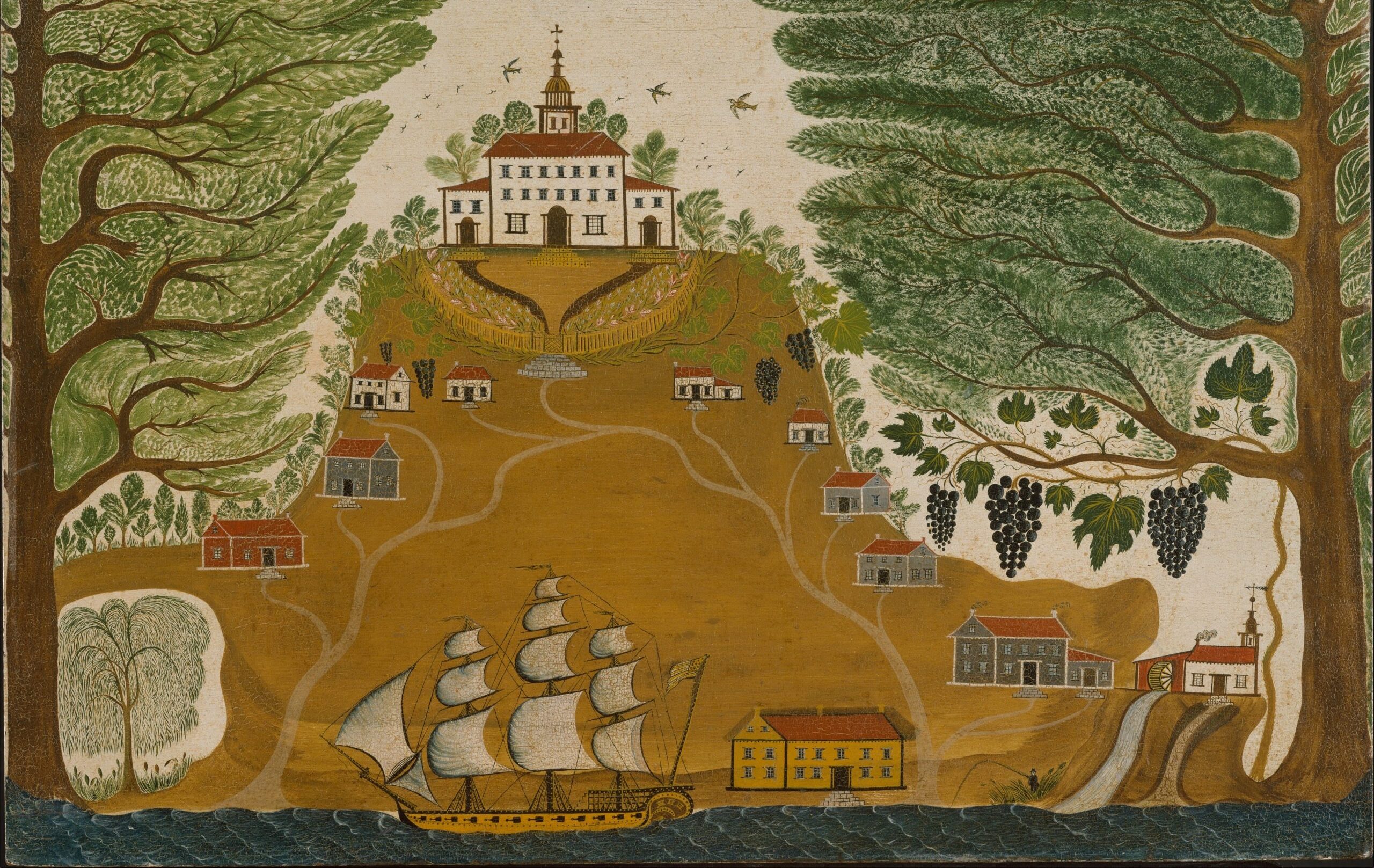
The Plantation, unknown author, oil on wood, 1825. The Metropolitan Museum of Art, Gift of Edgar William and Bernice Chrysler Garbisch, 1963.