By Gaëlle Perron
Edited by Louane Biquin and Natalie Hrga
H.D.’s HERmione, published posthumously in 1981, traces the author’s first steps as an artist. The novel fictionalizes her formative experiences after her departure from Bryn Mawr, in the form of a roman à clef. Writing the novel around 1926, H.D. retroactively analyses the genesis of her authorial identity (Friedman 83). Crucial to the realization of her artistic potential was her relationship with Frances Gregg, represented by Fayne, and her detachment from Ezra Pound, called George in the novel. Considering both of these relationships and how they overlapped, H.D. writes about the generative power of the exploration of her lesbian desire and the subsequent, albeit partial, release from heterosexist boundaries. Forging a path for her development as a female author, H.D. carves a space for herself out of the patriarchal structures of the “Dorian ideal” and pederastia.
Hermione aligns herself with the image of the ancient Greek soldier, engaging in the “Dorian ideal,” which elevates Sparta as the best of the Greek states on account of its martial success and athletic discipline (Gregory 92). H.D. repeatedly alludes to Spartans—primarily using the Greek terms “Laconian” and “Lacedaemonian”—and their military fame to characterize Hermione. Among the allusions to literary and mythological characters from ancient Greece, H.D. pays specific attention to Pheidippides, the famed courier who raced from Athens to Marathon in a day, and the Spartan soldiers who fought and died at the Battle of Thermopylae, immortalized by an epitaph by Simonides—“O passer by, tell the Lacedaemonians that we lie here obeying their orders” (Mackail 3.4). Pheidippides was Athenian rather than Spartan, but his athleticism as a long-distance courier displayed the rigour and discipline required by the Dorian ideal (Griffiths). Moreover, his legend is tied to the Spartan military as he was tasked with calling upon them to help his people during the Battle of Marathon. The allusion to Pheidippides intentionally draws a connection between male athleticism and the act of message-bearing. The allusion to the Simonides’ epitaph reiterates this connection between the roles of soldier and messenger: it is addressed to a “passer by,” charged with the transmission of the soldier’s message as they posthumously ask to be remembered as having fulfilled the expectations of the Dorian ideal (Mackail 3.4). H.D.’s allusions to the Dorian ideal in HERmione are thus overlaid with the desire to communicate. Hermione is positioned as a successor of the Spartan soldiers’ tradition of message-bearing. Her embodiment of the ancient soldier through Dorian allusions aligns her with male athleticism and, concurrently, the role of messenger. Furthermore, Hermione’s identification with the classical figures of the Dorian ideal necessarily includes Fayne, her lover and double in the novel. At the beginning of the novel, Hermione contemplates her rejection of her brother’s wife Minnie as a sister, and conjures up the image of a true sister, one who “would run, would leap, […] lost on some Lacedaemonian foothill” (H.D. 8). Fayne is quickly understood to be the prophesied realization of this imagined sister. Together, they are identified as “the warriors of Leonidas,” the very same Spartan soldiers that died fighting at the Battle of Thermopylae (H.D. 213).
The allusion to male athleticism pertains not only to a gender reversal, as the two women identify with virtues of classical masculinity, it suggests the expression of non-normative desire. Eileen Gregory explains that the allusion to the Dorian ideal, beyond its reference to Spartan athleticism and martial discipline, also carries the implication of “the Spartan institution of pederastia, publicly sanctioned homoerotic unions between older and younger men” (92). The allusion to male athleticism in the novel thus implicates the love between male homosexuals, embodied by Hermione and Fayne. Drawing on the literature of the Victorian fin de siècle and particularly focusing on Algernon Charles Swinburne, whose poetry is mentioned frequently in HERmione, Cassandra Laity explains the aestheticization of the “boy androgyne” as it leads to “statue love” (63, 65). The boy androgyne is the figurehead of the Dorian ideal in its homosexual implications. Often found in literature and art as a marble statue inherited from ancient Greece, he is portrayed through “whiteness” and “the transparently veined white body” (Laity 65). The whiteness of the boy androgyne aligns him “with the immortal” and erases the “impurity of contingent, mortal life,” corroborating the classical qualification of pederastia as the highest form of love (Gregory 95, 93). In HERmione, the allusion to the boy androgyne lies in the “color code” of Hermione’s homosexual desire, as Fayne is made to resemble the boy androgyne: “that blue-white face, face too-white eyes too-blue, eyes set in marble” (Laity 39; H.D. 159-60). She is also alluded to as the ghostly “white sister” of Swinburne’s “Before the Mirror,” as “a star shining white,” and associated with Pygmalion and his statue (H.D. 219, 221, 159). H.D. thus reinforces the identification with the pederastic structure through this color code.
In classical tradition and its Victorian and Romantic revivals, pederastia is valued as the highest and purest form of love, “reconcil[ing] both intellect and eros” (Laity 63). The homosocial structure ensures the sexual and intellectual education of a younger man by the self-actualized older mentor, promoting the perpetuation of the Dorian ideal. It is valued even above heterosexual relationships. In HERmione, the projection of the pederastic model onto Hermione and Fayne elevates their relationship above that of Hermione and George. Fayne encourages Hermione’s intellectual and artistic potential, while George stifles it, confining her to his model of poetic excellence. The homosexual bond in the novel promotes authorial expression, whereas the heterosexual bond “smudge[s]” it out (H.D. 71). The traditional structure of pederastia, however, from ancient Greece to the Romantics, excludes women altogether, finding their “love as base, animalistic, and inferior to the higher love between men” (Laity xvi). Therefore, H.D.’s association of lesbian desire and pederastia is oxymoronic and “poses serious constraints to the woman writer” (Gregory 91).
Yet, by recontextualizing her nexus of classical allusions, H.D. justifies the layering of these two contradictory expressions of non-normative desire. First, in Hermione and Fayne’s identifications with classical figures, the Dorian ideal extends beyond the Spartan soldiers and is applied to the allusion to a Greek hunter/huntress. Hermione imagines Fayne, and by extension herself, as “a boy hunter” with “a strap holding arrows” on her shoulders (H.D. 159; emphasis added). She tells Fayne “[she] might have been a huntress” imagining “a boy standing on bare rocks,” highlighting the implicit androgyny of this figure (H.D. 159; emphasis added). Fayne’s characterization as a hunter/huntress alludes to the Artemisian character of Atalanta. This Greek huntress defied gender expectations by performing the virtues of ancient male athleticism. When her father decided she should marry, Atalanta challenged her suitors to a foot-race (Jost). In HERmione, the allusion to Atalanta is positioned as part of the Dorian ideal, aligned with Pheidippides and the Spartan soldiers as she refutes her feminine attributes and runs like a male athlete. Second, H.D. uses the voice of the male athletes to call upon Hermione, coming to her as an ancient chorus propelling her into action. The narrative adopts the voice of the Spartan soldiers, chanting a refrain of “run on and on, run on and on” (H.D. 215). The chorus reformulates the ancient Spartan epitaph, identifying Hermione as the “passer by” entrusted with the transmission of the message of the dead soldiers (Mackail 3.4). In her allusions to these male athletes, H.D. positions Hermione as their heir or successor, tasked with carrying their pederastic tradition and perpetuating the Dorian ideal. Hermione’s role as an emerging writer thus bears the great responsibility to transmit “ancient knowledge” and “serve the domain of the inexpressible” (Gregory 125).
In “H.D.’s Early Decadent Masks and Images,” Laity argues that H.D. and her female contemporaries embrace the Romantics as “a reconstructed ‘feminine’ tradition” (32). While male modernists forcefully rejected the Romantics, finding them to be effeminate, H.D. creates an alternative modernist lineage, reclaiming their expression of non-normative desire to incorporate female and lesbian sexuality (Laity 35). In HERmione, H.D. acquires this literary tradition “by great labour,” forcefully carving out a space for the female author celebrating lesbian desire in male-dominated literary and cultural institutions (Eliot 38). The ancient Dorian ideal and its pederastic model “has a simultaneous existence” with the work of H.D., growing and expanding with her assertive insertion of Hermione and Fayne’s lesbian desire and female authorship (Eliot 38). Lesbian desire, structured through the allusion to pederastia, is placed at the core of Hermione’s intellectual and artistic development, as H.D. shows that the inclusion of a female author within the male-dominated literary tradition proves to be artistically generative.
The intersectionality of homosexual desire and intellectual development is critically determined by the expression of sameness between Hermione and Fayne. As Rachel Blau DuPlessis and Susan Stanford Friedman have found, Hermione’s love for Fayne is understood as “self-love, through the substitution of someone as similar as possible to the self” (DuPlessis and Friedman 218). In the novel, this sameness points to a projected form of narcissism. Following a Freudian explanation for homosexual desire, George alludes to Hermione as “Narcissus in the reeds” or “Narcissa,” after she confesses to him her love for Fayne (H.D. 165). Initially, the women’s sameness seems to threaten the hierarchical structure of the pederastic model: what can the boy androgyne learn from his equal? In this regard, the relationship with George seems better fit for her development. George is perfectly suitable to take on the role of the older man in the pederastic model: he is an established author, has travelled more than Hermione, and is certainly more sexually experienced. He has more to teach Hermione than Fayne does, strictly speaking. Following Freud, Hermione’s bond with Fayne is understood as “a return to an infantile stage” which hinders Hermione’s maturation (Friedman 119). Nonetheless, as mentioned, the heterosexist conventions forced onto Hermione in her relationship with George are suffocating and ultimately destructive for her personal and artistic development. George’s superiority threatens Hermione, it does not inspire her. Her gendered position drastically accentuates the hierarchy between the mentor and the apprentice, and detracts from the intellectual development that is meant to occur. The sameness offered in her homosexual relationship takes away this threat and allows Hermione to prosper.
Hermione and Fayne are simultaneously identified as the mentor and the apprentice in the pederastic relationship. Fayne is aligned with the boy androgyne, the receiver of the older male’s wisdom. Beyond the association with statue-love and its color code, she is thought of as Hermione’s inferior in the allusion to Swinburne’s poem, “Itylus.” Hermione refers to Fayne as Itylus, the son of Procne who falls victim to his mother’s wrath against her husband, Itylus’ father. Fayne’s association with Itylus places her as Hermione’s inferior, her son and victim. Equally, Hermione is thought of as Fayne’s boy androgyne, described in the same color code—“white hands” wielding “white power”—and designated as“[Fayne’s] breathless statue” (H.D. 176 ,175, 159). The proposed hierarchy of pederastia is rejected in the lesbian relationship. Fayne and Hermione are equals, moving in and out of positions of superiority and inferiority. The suggested intellectual advantages of pederastia, which typically flow unilaterally from the older man to his inferior, are offered to both women simultaneously. Their homosexual relationship functions on the basis of sameness and mutual identification.
Analysing Fayne as Hermione’s mirror-image, as Hilary Emmett proposes, one comes to appreciate Hermione’s creation of a unified self, “gather[ing] her fragmented, pre-symbollic self into a perceived whole” (268). The homosexual relationship is thus formative for Hermione, rather than regressive as the Freudian model of narcissism suggests. Hermione is unable to identify with the heterosexual structures and “patriarchal script[s]” she is offered, and in which she repeatedly fails, as a daughter, a lover, and an intellectual (Johnston). In her relationship with her mirror-image, Fayne, Hermione produces an “alternative system of textualizing and gendering” (Johnston). Hermione and Fayne read one another as gendered texts external to the predetermined patriarchal structures into which they are forced (Johnston). Through the women’s recognized sameness and mirroring, Hermione’s lesbian desire is identified as the core of generative identification in which she frees herself from heterosexist confines and traces an alternative path to identity formation.
Additionally, though working within the pederastic structure that is gendered exclusively male, Hermione retains her progenitive power as a young woman. Once again relating to her relationship with Fayne, Hermione explicitly understands their bond as familial: “I am a sort of mother, a sort of sister to Her” (H.D. 154). She imagines that it is her own reproductive power that has materialized Fayne, thinking of her lover as “some amplification of [herself] like amoeba giving birth, by breaking off, to amoeba” (H.D. 154). The allusion to this form of reproduction is notably asexual, forsaking the need for heterosexual conception. Similarly, the allusion to Swinburne’s “Itylus” offers a familial model without a father-figure, in which Procne and Philomela are interchangeable mothers to Itylus, mourning him equally. Hence, Hermione’s progenitive power is independent from the institutions of patriarchy. Moreover, the amoeba’s “breaking off” is not destructive, as binary fission creates two whole independent selves from one mother cell. The analogy of the amoebae implies Hermione as a product of the reproduction, as the amoebae splits into two daughter cells. Hermione is both the mother and the daughter, rebirthing herself in creating Fayne as her twin.
Much of HERmione has been understood as the process of Hermione birthing—or rebirthing—herself. As stated, the production of Fayne is in and of itself the birth of Hermione. Moreover, Friedman suggests that the events of the novel “correspond to a four- or five-year period in [H.D.’s] life,” but have been condensed into a “gestational nine-month period” (Friedman 69). Following this significant alteration in the time period, the last part of the novel, during which Hermione is confined to her parent’s home surveilled by a nurse, is understood as a period of bed rest during the third trimester. After Fayne’s betrayal, Hermione’s health declines and she is placed under the care of Amy Dennon. This confinement is itself an allusion to the Chthonian myth of Persephone/Kore and Demeter. Hermione is hidden away for three months and notices how “[she has] almost missed winter,” mirroring Persephone’s imprisonment in the underworld while the winter season occurs above ground (217). Hermione’s period of confinement is thus aligned with Persephone’s katabasis, and her escape out of her home represents Persephone’s rebirth, out of the underworld and into the world of the living. Once outdoors, Hermione notices “[f]lowers creeping out from winter leaves,” alluding to the coming of spring that Persephone’s anodos represents (H.D. 215). Furthermore, Hermione’s escape is brought on by an epiphany she has as she speaks to Amy, in which her identification with the male athletes has led to a progenitive “project [forming] in her head, a project and a determination” (H.D. 208). She describes her need to “tell someone,” mirroring the male athletes’ urgency for transmitting their message (H.D. 208). Hermione imagines that once she delivers her project by telling someone, it “will fall from [her] forehead,” alluding to the mythical birth of Athena out of Zeus’ skull (H.D. 208; Hesiod 920-5). H.D. adeptly identifies a classical allusion that replicates the earlier allusions to asexual reproduction, particularly fitting in its genesis of a female intellectual.
Historically contextualizing H.D.’s classical allusions, one finds that HERmione’s narrative of rebirth reflects the conversation brought forth by modernist anthropologists and classicists. Scholars Jane Ellen Harrison and James George Frazer both studied ancient religion and ritual, coming to separate but interrelated “ritual theor[ies]” (Carpentier 11). Arguing that H.D.’s allusions to ancient religion and ritual is “in many ways antithetical to the approach […] of Frazer,” Gregory advances that there is an “uncanny parallelism between Harrison and H.D.” (110). Harrison proposed that, in ancient religion, “to be twice born is the rule, not the exception” much like the “savage” studied by anthropologists (105). She explored how the ancient Greeks’ religious rituals served as rites of initiation, culminating in the transition from the participant’s “belong[ing] to his mother and the women-folk” to “pass[ing] into the society of the warriors of his tribe” (Harrison 105). Harrison, unlike Frazer, applied her findings on the connection between religion and art, with ritual as a “bridge” between them, to the art of the modernist era (Carpentier 11). In Ancient Art and Ritual in particular, which Gregory suggests H.D. read, Harrison expresses that art functions as a rite, and that both “arise out of a ‘common human impulse’ for survival” (Gregory 111; Winick 98). In H.D.’s novel, the running scene presents the act of writing, Hermione’s artistic self-expression, as a rite of passage leading to her second birth, a radical act of self-creation. H.D.’s oblique familiarity with Harrison’s ritual theory seems to inform her conceptualization of Hermione’s artistic breakthrough as a second birth. The rite of passage concurrently frees her from her confinement at her parent’s house and marks her debut into the literary tradition, entering the “society of the warriors of [her] tribe”—in this case incorporating her into the Dorian ideal of male athleticism (Harrison 105; emphasis added). Accordingly, H.D. uses the vocabulary and imagery of reproduction, pregnancy, and birth to lead to Hermione’s artistic breakthrough in the snow.
For H.D., the act of writing serves a psychoanalytic purpose, as she uses it to clear her head of the muddles and confusions that hold her back, especially in her prose: “But in the novel I am working through a wood, a tangle of bushes and bracken out to a clearing, where I can see clear again”(Friedman 83; H.D. qtd in Friedman 34). Her work obsessively revisits formative events and relationships, retroactively understanding and reinterpreting them. H.D. emerges as a new self in the production of semi-autobiographical texts, her “personae emerg[ing] as the product rather than the producer of the writing” (Friedman 35). HERmione stages the writer’s earliest memory—as far as I can tell—of a conscious reproduction of the self through the act of writing. The novel perpetually witnesses Hermione naming and renaming herself, trying to “[find] the right name that could materialize that author” (Friedman 36). As Hermione is confined to her home in the winter, her mental confusion and the intervention of her nurse threatens the accomplishment of her rebirth. Her name, “Her,” becomes a “husk” that contains her: “Her will be incarcerated in Her” (H.D. 211, 210). Stuck in the husk of herself, the rebirth is prevented, until Hermione comes to the realization that naming herself is not enough. The process of regeneration cannot simply happen internally, it must create a “[s]olid and visible form” (H.D. 208). She acknowledges that this tangible self “was what she had been seeking” and what promises to complete the rebirth (H.D. 208). Returning to the description of Fayne as the boy androgyne, one understands that the creation of the self must be carried out materially. The boy androgyne’s idealized form is a statue, an objectified art piece. Hermione’s lesbian desire and identification with the boy androgyne directs her to create the self as a physical visible object, carving it out in marble. The use of the “hieroglyph[s]” instead of the alphabet signals once more Hermione’s “compulsion to embody herself in a sign” or a visual pattern to be interpreted (H.D. 219; Zaccaria 84).
H.D. presents the winter landscape outside Hermione’s home as the medium onto which she must create, where she must “[write] on presently” (217). The lawn offers her “white parchment” onto which she traces “her wavering hieroglyph” with her feet, which act as “pencils” (H.D. 219, 218). The whiteness of the snow alludes to the color code of the boy androgyne, presenting the lawn as a slab of marble out of which Hermione will carve the object of her desire and the rebirthed self. As such, running across the white field, Hermione literally inscribes the genesis of her female authorship onto the fabric of the male homosexual Dorian ideal. Spurred on by the voices of the Spartan soldiers who have chosen her as their modern messenger, Hermione embodies the male athlete, using its image as the model of her identity as an author and the site of her forceful entry into the male literary and cultural tradition it represents. Hermione carves out an alternative space for herself on the foundation of the tradition that rejects her existence. Embracing the Dorian ideal which she adopts from the Romantics, H.D. engraves her first act of authorial rebirth in a reconstructed feminine lineage of literary and cultural allusions.
This initial act of self-creation is tentative and exploratory, not entirely confident (DuPlessis and Friedman 213). One gets the sense that Hermione is conscious of her imposition onto a male tradition that does not accept her, as she figuratively finds her footing as an author. For instance, she “stepped carefully,” and looked back at her mark, finding it to be “uneven and one footprint seemed always to trail unsteadily” (H.D. 219). H.D., writing retroactively about this period of her youth, emphasizes her relative inexperience, leaving room for further personal development and confidence in her art. Her rebirth in the snow marks the beginning of her independent development as an artist, an initial act of authorial intention, rather than a fully realized identity formation. Her identification with the male athlete, though necessary at this stage in her life, is not entirely right, not quite fitting to the self-realization of the female author.
The climactic identification with the male athlete is reactive, as it stems from a rejection of normative femininity enforced onto Hermione by George. Before she gets to running, Hermione thinks of how George ascribed her as “essentially feminine” and identified her as a dancer, “danc[ing] under a pink lampshade” for him (H.D. 215). George thinks of Hermione’s artistic abilities as the gendered-female movement of dancing, rather than running. As she explores non-normative expressions of gender and sexuality, Hermione cannot embody the figure of the dancer. To do so would signify that she conforms to George’s demands, submits to his heterosexist limitations, and represses her independent authorial identity. Besides, expressing lesbian desire while under George’s influence is impossible. Consequently, the bodily expression of her writing is diametrically opposed to dancing, adopting the male form of athleticism. Her primary rebirth must be gendered masculine, to forcefully reject George’s impositions of female artistic identification.
In the 1935 poem “The Dancer,” H.D. revisits the idea of dancing as a physical representation of the act of writing. The poem is written several years after HERmione, as H.D. reflects on a more mature and self-aware version of herself. The poem summons Rhodocleia as its titular dancer, who is inspired by Anny Ahlers, a ballet dancer and actress admired by H.D. (Martz xxviii). The writer personally identified with Ahlers, who became “symbol in [her] mind,” and she grieved when the dancer died unexpectedly at the age of twenty-six (Martz 614n15). The poem presents Rhodocleia expressing herself through the movement of her body, “writ[ing] in the air with [her] foot,” and “slurring no word/ in the rhythm [she] make[s]/ the poem/ writ in the air” (“The Dancer” VI.171, II.67-70). The dancer is freed from a male presence, a third party referred to as “he” in this poem, who previously demanded that she dance for him and act as “[his] stylus” (“The Dancer” VI.158, VI.170). This figure—the “he”—alludes to an embodied figure of patriarchal male intellectualism. H.D. recognizes the men involved in the formation of her female authorship, acting simultaneously as sponsors and detractors. In HERmione, the “he” is personified by George, or more literally Ezra Pound. By revisiting the figure of the dancer introduced by George in HERmione, H.D. explores the identity of the female author as she reclaims a feminine representation of her artistry. In “The Dancer,” H.D. can express female authorship in the representation of the dancer, having found a fitting image in her identification with Ahlers. The poem, which moves through the speaker and the dancer’s relationship, suggests a non-normative and androgynous romantic and sexual relationship. Both persons’ identities fluidly move through masculine and feminine positions, suggesting “a sexual doubling, a bisexuality, in the ‘I’ and the ‘you’: both priest and priestess, male and female” (Zaccaria 68). The romantic and intellectual relationship in the poem resembles that of Hermione and Fayne, as both couples represent doubles, joined together in artistic expression of non-normative desire. Moreover, the dancer acts collaboratively with the speaker, as she is encouraged to “utter words/ that [the speaker] may/ take/ wax/ and cut upon [her] tablets” (X.266-70). The couple thus encourage one another to create art, creating a similar generative relationship to that of Hermione and Fayne.
HERmione offers H.D.’s first tentative identity formation as a female author, which relies on allusion to a male-dominated literary and cultural tradition. On the other hand, “The Dancer” presents a “tribute to the achievement and perfection of the female artist” (Maltz xxvii). The speaker and Rhodocleia, unlike Hermione, are allowed to use women’s art to express their lesbian desire as female authors. Tracing the female dancer in H.D.’s work, which is by no means limited to HERmione and “The Dancer,” provides a thread to track the progress of H.D.’s rebirths and semi-autobiographical representations of the female author coming into her own.
Works Cited
Carpentier, Martha C. “Jane Ellen Harrison and the Ritual Theory.” Journal of Ritual Studies, vol. 8, no. 1, 1994, pp. 11-26.
DuPlessis, Rachel Blau and Susan Stanford Friedman. “‘I had two loves separate’: The Sexualities of H.D.’s HER.” Signets: Reading H.D.,The University of Washington Press, 1990, pp. 205-232.
Eliot, T.S. “Tradition and the Individual Talent.” Selected Prose of T.S. Eliot. Edited and Introduced by Frank Kermode. Harcourt Brace Jovanovich, 1975, pp. 37-44.
Emmett, Hilary. “Prophetic reading: Sisterhood and psychoanalysis in HD’s HERmione.” Comparative American Studies An International Journal, vol. 14. no. 3-4, 2016, pp. 261-276.
Friedman, Susan Stanford. “‘H.D. — WHO Is She?’: Discourses of Self-Creation.” Penelope’s Web: Gender, Modernity, H.D.’s Fiction, Cambridge University Press, 1990, pp. 33-99.
Friedman, Susan Stanford. “Origins: Rescriptions of Desire in HER” Penelope’s Web: Gender, Modernity, H.D.’s Fiction, Cambridge University Press, 1990, pp. 100-136.
Gregory, Eileen. “Anthropology and the Return of the Gods: Jane Ellen Harrison.” H.D. and Hellenism, Cambridge University Press, 1997, pp. 108-125.
Gregory, Eileen. “Pagan Mysteries: Walter Pater and Romantic Hellenism.” H.D. and Hellenism, Cambridge University Press, 1997, pp. 75-107.
Griffiths, Alan H. “Phidippides.” Oxford Classical Dictionary. March 7, 2016. Oxford University Press. doi.org/10.1093/acrefore/9780199381135.013.4955.
Harrison, Ellen Jane. Ancient Art and Ritual. Oxford University Press, 1913. Project Gutenberg, EBook, 2005. https://www.gutenberg.org/files/17087/17087-h/17087-h.htm.
H.D. Collected Poems, 1912-1944, edited by Louis L. Martz, vol. 611. New Directions Publishing, 1983.
H. D. HERmione. New Directions Publishing, 1981.
H.D. “The Dancer.” Collected Poems 1912-1944, edited by Louis L. Martz, vol. 611. New Directions Publishing, 1983, pp. 450-550.
Hesiod. Theogony. Translated by J. Banks and Gregory Nagy, The Center for Hellenic Studies, https://chs.harvard.edu/primary-source/hesiod-theogony-sb/.
Johnston, Georgia. “H.D. and Gender: Queering the Reading.” The Cambridge Companion to H.D., Cambridge. Edited by Nephie J. Christodoulides, and Mackay Polina. Cambridge University Press, 2012. ProQuest, https://www.proquest.com/books/h-d-gender-queering-reading/docview/2138003384/se-2?accountid=12339.
Jost, Madeleine. “Atalanta.” Oxford Classical Dictionary. December 22, 2015. Oxford University Press, https://doi.org/10.1093/acrefore/9780199381135.013.895.
Laity, Cassandra. H. D. and the Victorian Fin de Siècle: Gender, Modernism, Decadence. Cambridge University Press, 1996.
Mackail, J. W. Select Epigrams from the Greek Anthology. Longmans, Green, and Co., 1890. Project Gutenberg, https://www.gutenberg.org/cache/epub/2378/pg2378-images.html.
Martz, Louis L. “Introduction.” Collected Poems 1912-1944, edited by Louis L. Martz, vol. 611. New Directions Publishing, 1983, pp. xi-xxxv.
Robinson, Matte, and Demetrios P. Tryphonopoulos. “HERmione and Other Prose.” The Cambridge Companion to H.D., Cambridge. Edited by Nephie J. Christodoulides and Mackay Polina. Cambridge University Press, 2012. ProQuest, https://www.proquest.com/books/hermione-other-prose/docview/2137996146/se-2?accountid=12339.
Winick, Mimi. “Jane Harrison’s Ritual Scholarship.” Modernist Women Writers and Spirituality, edited by Elizabeth Anderson, Andrew Radford, and Heather Walton, Palgrave MacMillan, 2016, pp. 95-114.Zaccaria, Paola. “Beyond One and Two: The Palimpsest as Hieroglyph of Multiplicity and Relation.” H.D.’s Poetry, edited by Marina Camboni, AMS Inc., 2003, pp. 63-88.
Feature Photo
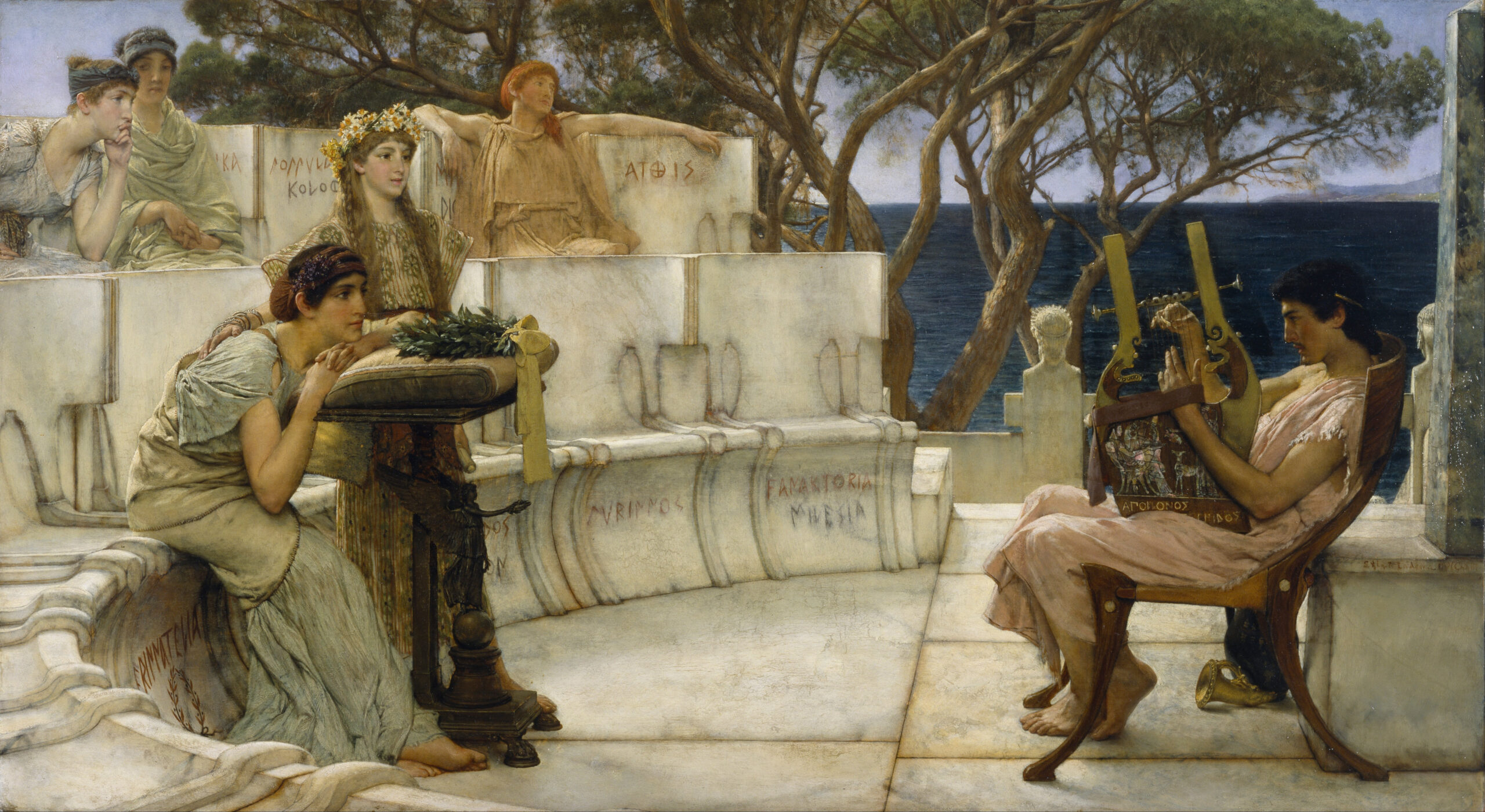
Sappho and Alcaeus, oil on panel by Sir Lawrence Alma-Tadema, 1881.