By Moyọ Alabi
Edited by Meera Panda and Megan Belrose
Before she was Bertha Mason—the madwoman locked in the attic—she was Antoinette Cosway, a white Creole girl who embodied complexity and nuance. Written as a postcolonial feminist prequel to Charlotte Brontë’s Jane Eyre, Jean Rhys’ Wide Sargasso Sea offers a seemingly radical reimagining of Antoinette’s life prior to her confinement. Set in post-emancipation 1830s Jamaica and Dominica, the novel explores the racial, cultural, and gendered tensions that shape Antoinette’s person and eventually lead to her psychological demise. After marrying an unnamed Englishman (The Husband), Antoinette is taken from her home country to the United Kingdom, where her husband isolates her in an attic. Fundamentally, Wide Sargasso Sea presents identity as a socially mediated construct predominantly shaped by external influences that skew the essence of the self. Rhys’ depiction of Antoinette’s unstable psyche can be read through Jacques Lacan’s analytic framework of the mirror stage, as articulated in his work Écrits. In Lacanian thought, identity emerges when the child sees themself through an external image and misrecognizes it as a unified self. Through this lens, one can explore Antoinette’s descent into madness as the result of repeated misrecognitions: through the mirror, through misnaming, and through racial and gendered projections. While Rhys profoundly explores Antoinette’s subjectivity and personhood, she reduces the Black women around Antoinette (Tia, Christophine, and Amélie) to symbolic and functional roles. Wide Sargasso Sea purports to critique colonial and patriarchal power by portraying Antoinette’s breakdown as a product of misrecognition. However, by privileging white femininity, the novel ultimately recentres white female suffering at the expense of Black female subjectivity, silencing the Black women who surround Antoinette and revealing the racial limits of Rhys’ anti-colonial narrative.
In the Lacanian psychoanalytic framework, the mirror stage describes a foundational moment in the formation of the ego during which the subject first identifies with an external image that appears more complete than their own lived bodily experience. In Écrits, Lacan defines this moment as “the transformation that takes place in the subject when he assumes an image” (2). The child’s reflection offers a unified, coherent form that starkly contrasts their fractured and unstable self; Lacan characterizes this condition as a “fragmented body-image” (5). Because this reflected image appears complete in comparison to the subject’s ruptured embodiment, they idealize it, taking this projected form to be themselves through a process known as méconnaissance (misrecognition), which structures the ego. This specular form, which Lacan dubs the “Ideal-I,” situates the ego “in a fictional direction,” assuring a sense of personal harmony whilst simultaneously alienating the subject from their own bodily experience (2). Thus, the mirror stage constitutes the subject’s entry into the Imaginary Order—an arrangement derived from images and the (mis)identifications they generate, through which the subject continually works to secure a sense of wholeness. Crucially, Lacan’s account of the ego emphasizes that this idealized coherence is always precarious. Because the ego depends on an external image to mask its internal fragmentation, any disruption to that stabilizing figure threatens to re-establish the subject’s sense of disorientation.
Antoinette’s psychological disintegration can be read through the mirror stage; the colonial and patriarchal structures intensify the alienation she feels. She repeatedly fails to affirm her identity through constructs that distort her self-image. Her instability is most explicit in her scene with The Husband, where she states, “So between you I often wonder who I am” (76-77). The phrase “between you” amplifies her fractured subjectivity, highlighting her sense of identity as contingent on her relation to external perceptions rather than a stable sense of self. Contrary to the unified illusion provided by the mirror stage, Antoinette experiences intensified alienation as a byproduct of the colonial patriarchal systems present in Dominica.
This psychological fracture is emphasized in the iconic looking-glass scene in part three, when Antoinette, now confined in England, reflects on her lost sense of self. She is forced to confront the disjunction between her self-image and lived identity:
There is no looking-glass here and I don’t know what I am like now . . . The girl I saw was myself. Not quite myself. Long ago when I was a child and very lonely, I tried to kiss her. But the glass was between us—hard, cold and misted over with my breath. (143-144)
The mirror image symbolizes the gap between Antoinette’s internal experience and the Ideal-I she cannot fully become. The cold, misted glass becomes a literal and symbolic barrier, representing the alienation produced by this constant misrecognition. As seen earlier in the text, Antoinette’s yearning to embody a colonial fantasy deepens this fracture; she admits she was “glad to be like an English girl,” even though she mourned the loss of Christophine’s cooking, her longtime Martinician nurse and caregiver (19). Her identification with Englishness detaches her from her Creole heritage. This split is violently enforced when The Husband renames her: “Bertha is not my name. You are trying to make me into someone else, calling me by another name, I know, that’s obeah too” (115). By calling her “Bertha,” The Husband imposes an identity onto her, becoming the Lacanian “other” who fixes her subjectivity from the outside. In doing so, he transforms Antoinette into a projection of his own racial and patriarchal fantasies, severing her from her own reflection. Rhys uses mirror motifs and naming to show how Antoinette’s identity never coheres. She is trapped between reflections that are racialized, patriarchal, and colonial—each promising recognition but resulting in her further alienation.
Antoinette’s Creole identity leaves her in a supposed racial in-between, rejected by both the Black and white communities that surround her. This liminal position incites Antoinette’s yearning for unity, symbolized through her idealized yet fraught relationship with Tia—a Black Jamaican girl and Antoinette’s only childhood friend. Tia symbolizes the stable racial identity that Antoinette will never be able to fully access. Even in the early stages of their childhood, the disconnect between the two girls is evident. The girls’ turbulent friendship is best illustrated by the dispute over who won the money at the pool: as Tia takes the coins, Antoinette lashes out, “Keep them then, you cheating nigger” (9). Although she feels immersed in Black-Caribbean culture, Antoinette’s whiteness puts her in a conflicting racial position while also revealing her internalized prejudice. Antoinette’s outburst demonstrates how colonial racism deeply shapes her identity, further intensifying her alienation by positioning her simultaneously within and against Black Jamaican culture. The novel repeatedly shows that Antoinette’s whiteness is contested; as a white Creole, she is not accepted by the Black Jamaican community, nor is she fully embraced by the English, who view white Creoles as culturally inferior and socially degenerate (Mitchell 152).
The fractured relationship between the two girls further deteriorates in a pivotal moment following the burning of the Coulibri plantation. As Antoinette mourns the loss of her childhood home, she notices her old friend Tia in the crowd. In an attempt to restore their friendship and feel some semblance of wholeness, she runs towards Tia, expressing her desire to “merge” with her friend: “I will live with Tia and I will be like her” (27). This line further affirms Antoinette’s need to resolve her liminal racial status by adopting what she sees as Tia’s coherent Black identity. But this desire is rooted in fantasy and misrecognition; Antoinette does not truly understand Tia’s racialized position and its societal repercussions. The failure of this identification is violently enacted in the following lines as Tia throws a rock at Antoinette. After being struck, Antoinette recalls, “I looked at her and I saw her face crumple up as she began to cry . . . It was as if I saw myself. Like in a looking-glass” (28). Tia’s harsh rejection exposes the impossibility of Antoinette’s idealized Black belonging. Previously positioned as a specular, romanticized image, Tia’s function as an Ideal-I shatters, fracturing Antoinette’s imagined unity. This scene marks the beginning of Antoinette’s psychological break, leading to a broader rupture in her sense of racial, cultural, and national belonging under colonial rule. While Rhys explores Antoinette’s alienation with careful nuance, Tia does not receive the same attention. She remains a symbolic figure used to reflect Antoinette’s fragmentation, rather than being a character granted complete narrative subjectivity. Rhys dramatizes Antoinette’s racial alienation through her bond with Tia, turning Tia into a symbolic figure representing Antoinette’s fantastical and unattainable identity. In contrast, Tia lacks narrative interiority and remains a flat character, functioning as a figurative device rather than a fully realized subject.
Christophine is one of the novel’s most morally authoritative and perceptive figures, yet she is denied independent narrative space. By confining her to the roles of Antoinette’s maternal anchor and narrative foil, Rhys withholds Christophine’s agency. Christophine alone resists The Husband’s control, offering spiritual and political clarity. Despite her wisdom, the narrative mediates her voice by filtering it through others’ perspectives. As soon as Christophine enters the plot, she is immediately reduced to property, as Annette recounts: “She came with the place, she was your father’s wedding present” (6). The language of ownership casts Christophine as an inherited object to be passed down from generation to generation rather than as a person. This moment sets the tone for her restricted subjectivity. Though Christophine provides guidance, labour, and insight, Rhys never narrates her presence on her own terms. Instead, she exists in service to others, aligning her with the “Mammy” stereotype: a faithful and obedient, often dark-skinned, Black domestic servant who is content in her subjugated position, symbolizing the “dominant group’s perceptions of the ideal Black female relationship to elite [w]hite . . . power” (Collins 72). In archetyping Christophine as the maternal Mammy, Rhys appropriates Black female labour and resistance whilst withholding autonomy, reinforcing a racial hierarchy in which Black women solely exist to stabilize white subjectivity rather than possess subjecthood of their own.
Although the narrative attempts to reduce Christophine to a mere object, she subverts this restriction through her political awareness. This is best seen in her critique of post-emancipation and colonial laws: “No more slavery! She had to laugh! These new ones have Letter of the Law. Same thing” (11). Through her laughter, Christophine dismantles the illusion of freedom, recognizing the irony in this colonial rebranding. Her voice offers one of the most incisive critiques of colonialism in the novel, but with the caveat that it is mediated through Antoinette’s perspective. This keen political consciousness becomes more threatening when it is no longer abstract and is directed at The Husband himself. Christophine confronts the exploitation of Antoinette, acting as her voice when she is unable to speak for herself: “Everybody know that you marry her for her money and you take it all. And then you want to break her up, because you jealous of her” (120). This blunt accusation cuts through the justifications The Husband offers throughout the novel, exposing the violence of both colonialism and patriarchy in a single sentence. Christophine’s direct challenge briefly unsettles The Husband’s colonial authority, leaving no room for denial. In response, he immediately retreats into defensiveness, stating, “I’ll have the police up, I warn you. There must be some law and order even in this God-forsaken island” (126). The Husband’s ultimatum reinforces colonial power dynamics and suppresses Christophine’s resistance through the power he does have: legal and imperial force. His threat makes clear that he cannot, and will not, tolerate Christophine’s defiance. Her voice, while powerful, is immediately criminalized. Through his attempt to reassert control, it is evident how quickly white patriarchal authority moves to control and silence Black female voices; Black women’s autonomy and Afro-Caribbean cultural practices are criminalized through colonial law (Olmos and Paravisini-Gerbet 155-169). After this lengthy confrontation, Christophine disappears from the narrative as she “walked away without looking back” (127). There is no closure or explanation, just removal. The Black woman who challenged colonial power most directly is silenced not just by The Husband, but by the novel itself. Her autonomy, once asserted, becomes a narrative threat and the novel punishes her for it.
Whilst Christophone represents the Mammy figure in Rhys’ narrative, Amélie, a young Biracial servant, is rendered through a racialized and hypersexualized lens that flattens her narratively. Though Amelie plays a crucial narrative role in destabilizing Antoinette’s fragile position, she herself is granted little psychological depth. The Husband sexualizes her early on, describing her as “a lovely little creature but sly, spiteful, malignant perhaps, like much else in this place” (45). This exoticizing language frames her as both alluring and threatening—an object of desire and suspicion. By positioning her this way, the narrative reinforces Amélie’s role as a racialized other, denying her subjectivity and reducing her to a vessel for The Husband’s dominance and control. This narrative flattening becomes evident in Amélie’s confrontation with Antoinette: “‘I hit you back white cockroach, I hit you back,’ said Amélie. And she did” (74). The insult once again exposes Antoinette’s racial liminality through the derogatory name “white cockroach,” as she is mocked for not fitting into either the Black or white category. Yet, the narrative does not dwell on Amélie’s motivations or interiority; instead, the moment acts primarily to intensify Antoinette’s instability. In doing so, the narrative preserves its focus on Antoinette’s decline, using Amélie’s body to register and amplify the protagonist’s fragmentation.
Amélie’s dehumanization is most clearly revealed during her sexual encounter with The Husband. She is denied interiority or emotional presence; the moment is viewed entirely from his perspective. After sleeping with her, he remarks: “I had not one moment of remorse. Nor was I anxious to know what was happening behind the thin partition which divided us from my wife’s bedroom” (109). The lack of formality highlights how little emotional or narrative value Amélie is given. By morning, even this illusion collapses: “In the morning, of course, I felt differently. Another complication. Impossible. And her skin was darker, her lips thicker than I had thought” (109). This shift emphasizes The Husband’s exploitative racial tensions; Amélie’s sexuality initially offers him power and pleasure, but once her narrative function is fulfilled, her racial difference becomes a source of discomfort. Her desirability is revoked as quickly as it was rejected, reinforcing the Jezebel stereotype, a slavery logic that depicts Black women as a hypersexual and deviant figure with an insatiable appetite for sex (Collins 81-83). Unlike Christophine, who is cast in the Mammy role as a nurturing caregiver, Amélie represents the dangerous and exotic other. Both stereotypes reduce Black women to symbolic functions, flattening them into narrative tools rather than granting them complete subjectivity.
Amélie’s role concludes with compensation, a transactional dismissal from The Husband, commodifying her Blackness and her femininity. She is “satisfied,” discarded, and finally, paid: “I wanted to give her a present . . . she took it with no thanks and no expression on her face” (109). The cold, detached, transactional tone mirrors her symbolic function in the novel. She is a temporary disruption to Antoinette’s marriage and identity, then erased. Her silence at this moment is telling; it reflects the narrative’s refusal to grant her emotional depth or agency. Amélie’s body becomes a site where colonial and patriarchal anxieties are played out. Her sexuality serves not to develop her character but to expose The Husband’s entitlement and to further Antoinette’s psychological disarray. Amélie’s presence reinforces how Black women’s bodies and sexuality are used symbolically within the colonial and patriarchal power dynamics of the novel. She is not a subject but a function, only made visible when beneficial to the white narrative and then quickly silenced when her autonomy becomes inconvenient. Even as Wide Sargasso Sea critiques colonial structures, it participates in them by denying Amélie whole narrative subjectivity.
Through Antoinette’s psychological breakdown, Wide Sargasso Sea critiques the violence of colonialism, patriarchy, and racial misrecognition. By analyzing Antoinette’s narrative trajectory through Lacan’s mirror stage, it becomes apparent how Antoinette’s identity fractures under the weight of external projections; however, in doing so, Rhys reserves full narrative depth for Antoinette alone. Black women, such as Christophine, Amélie, and Tia, remain symbolic figures—vital to Antoinette’s development but denied the same complexity. While the novel challenges empire and gendered power, it reinforces racial hierarchies by flattening the very women it claims to foreground. In giving a voice to one silenced white woman, Rhys renders the others voiceless.
Works Cited
Collins, Patricia Hill. Black Feminist Thought: Knowledge, Consciousness, and the Politics of Empowerment. 2nd ed., Routledge, 2008.
Fernández Olmos, Margarite; Paravisini-Gebert, Lizabeth. Creole Religions of the Caribbean: An Introduction from Vodou and Santería to Obeah and Espiritismo. 2nd ed., New York University Press, 2011.
Lacan, Jacques. Écrits: A Selection. Translated by Alan Sheridan, 1st ed., Routledge, 2001.
Mitchell, Dayo Nicole. Review of “White Creole Culture, Politics and Identity During the Age of Abolition.” Caribbean Studies, vol. 36 no. 1, 2008, p. 151-154.
Rhys, Jean. Wide Sargasso Sea. Penguin Books, 2011.
Feature Photo
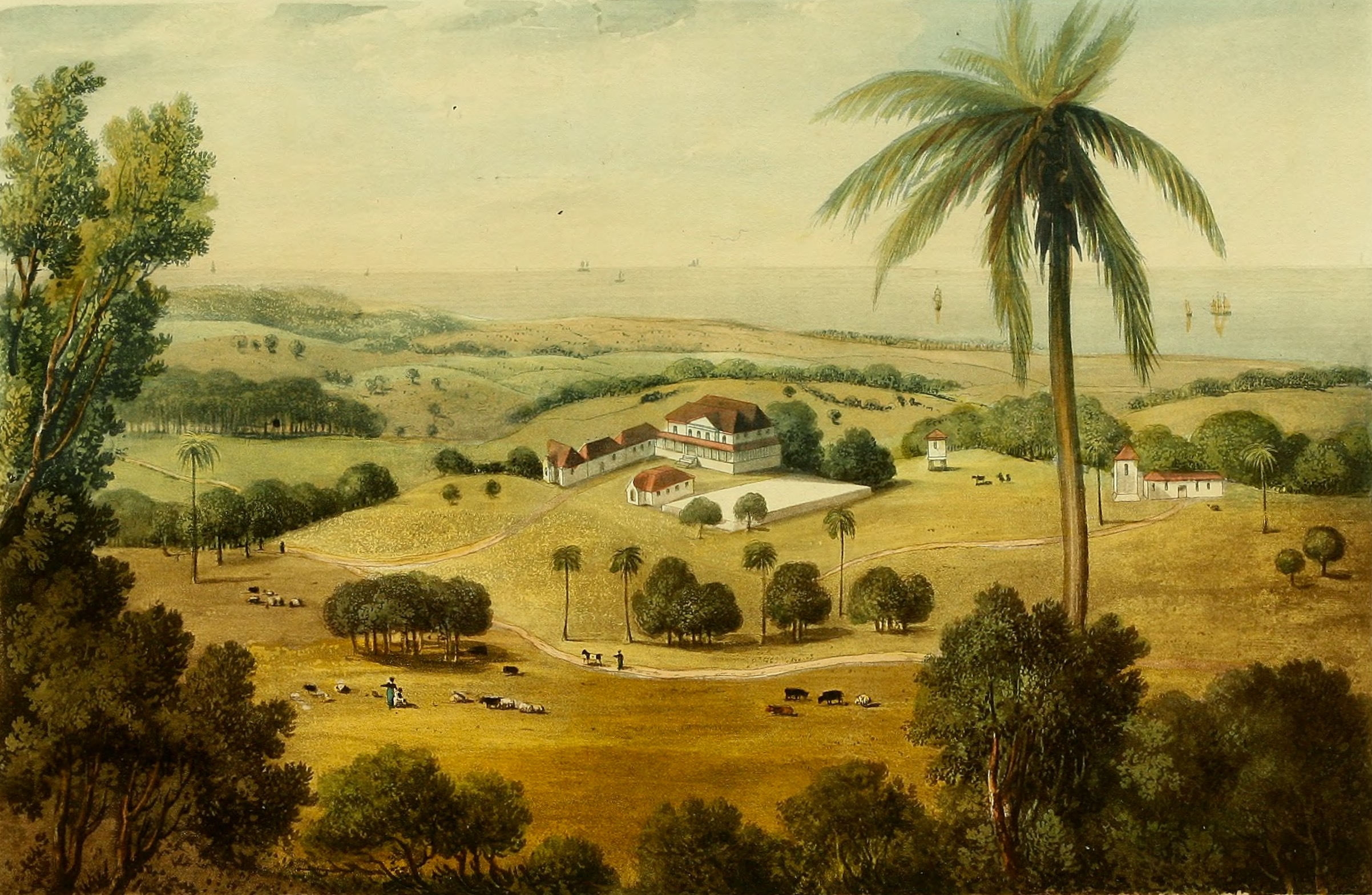
Drawn by James Hakewill, engraved by Sutherland Cardiff Hall, St. Ann’s. Published July 1, 1824 by Hurst Robinson & Co.