By Eren Atac
Edited by Louane Biquin and Meera Pande
Ingmar Bergman’s 1966 surrealist thriller Persona follows a nurse, Alma, assigned to care for Elisabet Vogler, an actress who has suddenly gone mute. As the two women isolate themselves in a seaside cottage, their identities begin to blur. The film acknowledges our dependence on visual language while subverting its traditional use.It eschews several of film’s narrative conventions in favor of intense visual compositions, which, above anything else, are used to generate affect. The film is meant to perplex the viewer and immerse them in its aesthetic rather than tell a traditional story. It is more than just visual confusion, though—meaning is embedded throughout every layer of imagery. Thus, in a sense, affect constitutes Persona’s plot. To this end, sensory experience and its influence on perceptions are a recurring motif. One example of meaning encoded through this device comes midway through the film in the “glass-shattering” scene (45:15-48:30). In this sequence, Persona uses visual filters like curtains, glass, and the medium of film itself to expose the fragility of perception and our reliance on the veils that shape it, culminating in a breakdown of the cinematic illusion.
The glass-shattering scene embodies one of Persona’s most central dichotomies: the conflict between perception and reality. The scene starts with a wide shot after Alma, the nurse, has broken a glass near the porch. She begins to clean up the mess, but after seeing her patient, Elisabet, standing in the doorway, she leaves a shard in the middle of the path. Alma returns to her seat, and the camera lingers in a tight close-up, capturing the tension in her expression. Behind Alma, Elisabet drifts through the frame, her figure clouded through floor-to-ceiling windows and sheer curtains. This expressionist technique lends the viewer an entry into Alma’s interiority. To her, Elisabet is only visible through layers of veils—there is always some form of barrier between them, whether physical or psychological.
Bergman stages the encounter through layers of corporeal and visual obstruction, using glass and framing to materialize the emotional distance between Alma and Elisabet. This dynamic becomes apparent when Elisabet briefly pauses to gaze at Alma through the window. As Elisabet steps outside the house, the camera pans down to her feet, barely missing the glass shard in her path. It pans back to Alma, whose gaze is fixed on the shard. This sequence recurs in a reverse shot. Only after Alma gets up and walks out of frame does Elisabet step on the glass, uttering a quiet gasp of pain. Now inside, Alma is filmed from behind a curtain. She walks up and draws the curtain back, looking through the window. A reverse shot reveals Elisabet outside, her gaze returning to Alma, the two women once again separated by a layer of glass. Crucially, the camera never permits the viewer to see Elisabet’s face unless she is behind one of these physical veils—the two shots where Elizabet’s face is clearly in view are filmed from behind a window. On a physical level, the glass represents a barrier between inside and outside the home. On a more interpersonal level, Alma and Elisabet share no words throughout the sequence. Their faces are never shown in the same frame, and they do not communicate in any conventional sense. These factors culminate in a monumental distance between the two women—one that Alma seeks to traverse.
Alma’s perception of Elisabet drives the action in these shots, communicated by the camera’s positioning throughout the scene. If the windows represent a barrier that governs Alma’s perception of Elisabet, the broken glass takes on a new meaning. The shattering of the glass signifies an attempt to break this barrier, and the choice to leave it on the ground, lingering in the mise-en-scène, represents a resistance toward reestablishing the status quo of noncommunication. By allowing the glass to remain in Elisabet’s path, Alma preserves evidence of her defiance, refusing to restore the tenuous perception she has so far maintained. The broken glass is evidence of Alma’s attempts to transcend perceptual barriers, but its presence is used to draw out another form of “evidence”—corporal pain. Because Alma cannot truly “see” or communicate with Elisabet, she seeks to perceive her in other ways: through an audible exclamation or a visible reaction to pain. Involuntary reactions, such as gasps or flinches, are universal human behaviors. By eliciting them, Alma attempts to affirm that Elisabet is responding in a way that aligns with her expectations of how a person should behave. In other words, Elisabet’s reaction to pain is a way for Alma to ground herself. It affirms Elisabet’s humanity in her mind, attempting to bridge the interpersonal gap and thus circumvent the veils. Ironically, this reaction only comes after Alma has left the frame and gone inside, where the windows now separate them, showing that it failed to break down the perceptual barrier. This failure is significant because it reveals the impossibility at the center of the film: perception cannot secure access to another’s interiority. This reality is again demonstrated at the sequence’s midpoint when Alma pulls back the curtain to look at Elisabet. The curtain is drawn open, but the window still separates them, and neither character shares the frame during the ensuing shot-reverse shot sequence. This point in the scene is where Bergman expands the scope of the perceptual barrier to encompass not only the two characters but also the film’s audience.
Shortly after a cut back to Alma behind the window, jagged lines flash across the screen and the film appears to burn up, leaving only an expanse of white. By burning the film, Bergman exposes his medium—the very essence that constitutes Persona as it exists in our world. This shattering of the medium withdraws the viewer from the bubble of the diegesis, thus revealing film itself as another visual filter upon which our perception depends. It is no coincidence that this exposure occurs when it does; as soon as Alma pulls the curtain back, our own “veil,” the medium of film, is likewise shattered, fractured by jagged lines resembling broken glass. Disembodied backward voices can be heard, and images spliced to resemble a sequence from an early twentieth century film—a man dressed as a demon, a chase scene, and a person in a skeleton costume—briefly haunt the screen, lasting mere frames. The early film sequences, the hand nailed down, and the eye do not just contribute to the film’s surreality by disorienting the viewer; they lay bare the medium for the construct it is. The imperfectly preserved, flickering early film sequences expose cinema’s material fragility, just like the prior burning of the film. They also remind the viewer of cinema’s evolution from a primitive, more unmediated way of seeing to an illusion of seamless, immersive storytelling, as the world of Alma and Elisabet we know is predicated on decades of development and decisions made by filmmakers. But this evolution is secondary to Persona’s, and many other films’, true goal: the production of affect.
Flashing back to a white screen, a pained voice cries out. Then, an image of a hand being nailed to a board briefly appears before being replaced by an extreme close-up of an eye, which proceeds to linger and zoom in even further. These emphases on sensory experience further the film’s goal of generating affect. They jolt and frighten us, eliciting a raw sensory experience. The modern diegesis, in all its sophistication and years of progress, is ultimately unnecessary for this objective; disjointed, seemingly nonsensical sequences generate just as much raw sensory experience as any well-crafted modern narrative. Such is the power of the medium itself over the content it delivers. The hand and the eye bring us even closer to these sensory roots. They remind us of our biological senses, the most primal forms of veils whose capabilities and limitations govern our fragile perceptions. They also recall the sequence’s previous themes of visual perception and pain, priming us for a return to diegesis. As we fade from the eye to a blurred Elisabet, the manipulative power of cinema is laid bare. The sequence is warped in several ways: it initially plays in slow motion, it is heavily blurred, and the frame freezes for a moment. An eerie soundtrack also plays throughout. Now that all the groundwork has been laid, Bergman almost toys with the viewer, employing seemingly arbitrary methods of distortion to highlight cinema’s narrative force. We are only permitted to see Elisabet clearly when she looks through a window with the curtain drawn—our perception of her is still governed by the presence of these perceptual barriers, one of which cinema itself is now revealed to be. However, the relationship has changed. The camera no longer points at Elisabet from behind a curtain or a window; we are permitted to see her clearly, without visual barriers, for the first time in the sequence. After going through Bergman’s sensory trial by fire, the viewer has evolved to a state of cinematic clarity—the frame accordingly jumps into focus. Elisabet walking outside into the sun signifies the viewer’s newly gained awareness of their existence under the medium’s hegemonic veil. We follow her into the boundless space of nature, no longer withheld by walls and windows, illuminated by the light of the sun. But there is still a camera between us.
Bergman reminds us that just as barriers mediate Alma’s view of Elisabet, our perception of this constructed world is limited, governed by the veil that lies at the auteur’s fingertips. Through this unification of viewer and character experience, Bergman achieves a synthesis of diegetic storytelling and affective immersion. Whether it is the sting of a hand nailed down, the jolt of an auditory scare, or the disorientation of fractured imagery, Persona uses sensory manipulation to destabilize the viewer’s grasp on reality. By rupturing the diegesis, Bergman not only exposes the fragility of our perceptions but also forces us to confront how deeply these perceptual veils shape our understanding of both film and the world beyond it. Just like how Alma needed to hurt Elisabet to confirm her humanity, Persona deconstructs the viewer’s concept of cinema to affirm that we are, in fact, watching a movie.
Works Cited
Svensk Filmindustri; en film av Ingmar Bergman. Persona. [New York]: The Criterion Collection, 2014.
Feature Photo
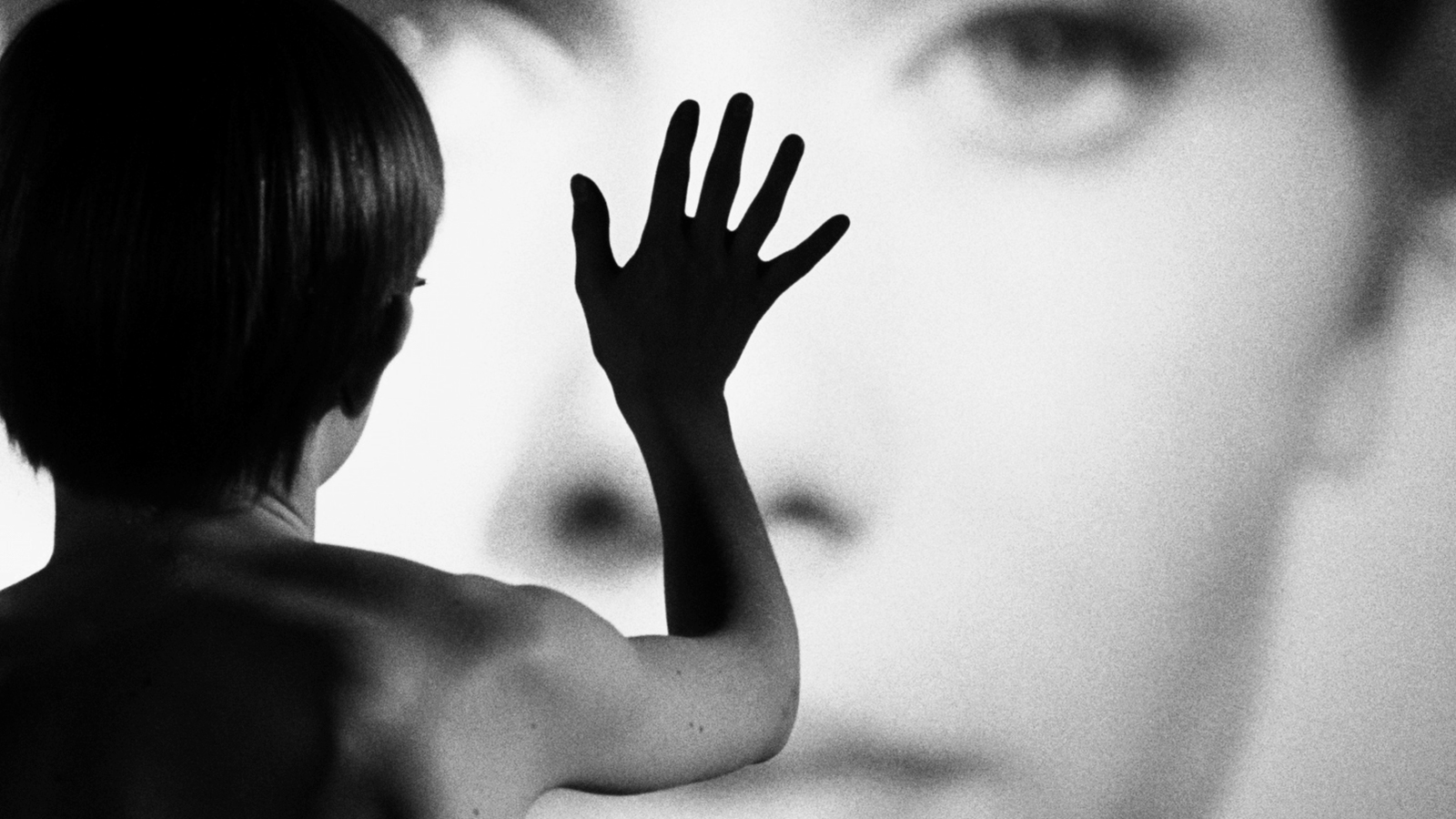
Ingmar Bergman, Persona, 1966. The Boy and Alma (Jörgen Lindström and Bibi Andersson). Courtesy of The Criterion Collection/AB Svensk Filmindustri.