By Logan Wright
Edited by Kristina Tham and Olivia Wigod
“Maud Martha is a lovely little novel,” Gwendolyn Brooks writes in her 1984 self-interview, “about a lovely little person wrestling with the threads of her milieu” (408). With this characterisation, Brooks implicitly identifies the relation that structures her book; namely, that between the intimate, fine-grained consciousness of the titular character through whose eyes the reader witnesses a coming of age from girlhood to adulthood, and the dense social and spatial “threads” of Chicago’s South Side that surround her during this process. Brooks stages this relation formally: Chicago’s South Side topography reaches the reader only as Maud Martha takes it up—moment by moment, from within her shifting perceptual field. Across the novel’s thirty-four vignetted chapters, settings arrive in discontinuous glimpses, each demanding the reader’s spatial reorientation as Maud Martha reinhabits and reconsiders both domestic interiors and public urban environments. Through the character’s continuous registering and reregistering of her world’s textures, constraints, and minor affordances, Brooks insistently returns the reader’s attention to her way of seeing the spaces around her, as well as to the subtle ways her imagination revises what those spaces can mean.
In this essay, the spatial-perceptual relation Brooks establishes serves as a conceptual frame for the argument that Maud Martha reimagines Black girlhood not as a brief, superseded stage of development but as an enduring spatial practice that organises how the marginalised subject perceives and inhabits her world. This reimagining takes shape through the sophisticated consciousness with which Brooks endows Maud Martha—a consciousness formed in childhood and persisting into adulthood as a “child-identified” habit of attention that lingers over small, ordinary details; remains alert to shifts in atmosphere; and persistently overlays the given world with alternative ways of seeing. As Maud Martha leaves the family home and transitions into married life, she carries these early-learned practices of looking, feeling, and imagining with her, quietly widening the possibilities of her constrained geographies. To trace that carryover, this essay proceeds through a series of theoretical lenses that clarify how Maud Martha makes and remakes space from within. In charting this development, Brooks suggests that by first turning inward to the intimate, imaginative spaces of youth and then carrying those geographies forward into adult life, Maud Martha develops everyday techniques for living within and gently resisting the racial and gendered structures of subordination that shape her milieu.
I. Childhood Orientation: Imaginative Geographies of the Yard
The opening vignette of Maud Martha introduces a seven-year-old girl whose sensory orientation to the world reveals a mode of aesthetic life-making rooted in the everyday. Though the sketch is titled “Description of Maud Martha,” it tellingly offers no physical description of her; instead, from its opening line, it defines her in terms of what she likes: “candy buttons, and books . . . and the west sky, so altering, viewed from the steps of the back porch; and dandelions” (1). The list moves from placeless pleasures (sweets; books) to spatialised ones (the view of the sky from her porch; the dandelions), such that a record of tastes opens onto a tiny, situated world. From the outset, Brooks figures Maud Martha’s inner disposition as deeply integrated within her personal geography. It is striking, then, that this grounded geography is immediately unsettled in the subsequent line. Brooks writes:
She would have liked a lotus, or China asters or the Japanese Iris, or meadow lilies—yes, she would have liked meadow lilies, because the very word meadow made her breathe more deeply, and either fling her arms or want to fling her arms . . . rapturously up to whatever was watching in the sky (1–2).
Here, each spatial element in the opening line is replaced by an imagined counterpart: ordinary dandelions are exchanged for lilies, the yard for a meadow, and the familiar west sky for a grander, more distant sky, overseen by “whatever was watching” in the clouds. The sublimity of these images, along with the repeated modal phrasing “would have liked,” marks these imagined substitutions as necessarily unrealised—desires that exceed the limits of Maud Martha’s world.
Having introduced the reader to these limits, Brooks dismisses the imagined elsewhere as quickly as she introduces it, returning bluntly to Maud Martha’s actual surroundings: “But dandelions were what she chiefly saw” (2). This abrupt shift between geographies and the attendant drop in scale from rapturous skies to dandelions opens a vertiginous gap between the imagined space and the real. The significance of the narrative’s out-and-back movement across this gap can be clarified by a term from geographical theory: “imaginative geography.” As articulated by Edward Said in Orientalism, “imaginative geography” names the “universal practice of designating in one’s mind a familiar space which is ‘ours’ and an unfamiliar space beyond ours which is ‘theirs’ . . . a geographical distinction that can be entirely arbitrary,” grounded in boundaries that may exist “only in our own minds” (54). This mental mapping unfolds in the opening two sentences of Maud Martha: the first anchors the familiar in the concrete details of the back porch and its dandelions, while the second posits an alluring, unfamiliar elsewhere. Crucially, this elsewhere is ill-defined. Maud Martha responds to the “very word meadow,” not to an image; her spatial imagining is thus based on verbal and affective response rather than lived experience. Brooks’ repeated use of “would have liked” underscores this experiential distance. Rather than countering the opening line of “What she liked” with “what she preferred,” Brooks insists on “would have liked” to mark lilies and meadows as counterfactual objects that do not belong to Maud Martha’s world—things she would like if they were part of her world but, because they are not, she does not. By briefly projecting Maud Martha’s consciousness into an indeterminate elsewhere, only to stage ontological instability there and thus return to the familiar, Brooks shows how inaccessible alternative geographies are to Maud Martha, even in imagination. By setting these initial bounds, she prepares the ground for the rest of the novel, in which any liberatory work of Maud Martha’s attention must occur not through escape into other spaces but through a reimagination of the constrained spaces she already inhabits.
The first such reimagining occurs in the subsequent line, where, having recentred the dandelions as the object of Maud Martha’s attention, Brooks begins to reveal the child’s penchant for finding loveliness in the humble, everyday things that surround her. In Maud Martha’s eyes, the dandelions are “Yellow jewels for everyday, studding the patched green dress of her back yard” (2). Maud Martha’s romantic appreciation of her surroundings, especially when read alongside the failed reach into alternative geographies in the preceding lines, marks a deliberate effort to rework and resist the imposed valuelessness of her assigned space. Sara Ahmed’s notion of “orientation” in Queer Phenomenology can help to further understand this effort. Ahmed argues that consciousness and the body are always oriented towards certain things and away from others, so that what is near, repeatedly faced, and within reach becomes the world one inhabits and the basis of what one can do (2–3). In Maud Martha’s case, the yard, with its patches and weeds, is not merely background scenery but the space that organises her sense of the real. Because it is most consistently within reach, her consciousness and body are compelled to face it repeatedly. Over time, this orientation sediments the yard into the little world she can inhabit and act within. Ahmed notes that such orientation is, in part, predetermined: we inherit certain “lines” of race, class, and gender that make some paths feel natural and others feel strange or impossible (5, 14–18). For a white middle class child, the “straight line” might lead towards manicured gardens and open fields, whereas for a Black girl on Chicago’s South Side the line leads back, insistently, to the cramped back yard.
Ahmed leaves room in this scheme for limited deviations. She defines “queer orientation” as a configuration of desires and affects that draws the individual towards objects that do not belong to the sanctioned field of value, thereby beginning to carve out a new line that, over time, opens a different way of inhabiting the world (3, 162). Though orientation is heavily shaped by intergenerational histories and power structures and thus cannot simply be overwritten, it is also lived and relived in each act of turning towards or away; reorientation constitutes a continual process requiring the deliberate pursuit and internalisation of an alternative habit of attention (10–12, 159). In Maud Martha’s act of revaluing her scrappy little yard, we see an emergent form of such reorientation. By imagining the dandelions as “jewels . . . studding the patched green dress of her back yard,” Maud Martha works both along and against her inherited line, widening the possibilities of her constrained geography (2). While she does not escape the yard or its poverty, still describing the grass as “patched” and acknowledging the yard as narrowly circumscribed, she nevertheless refuses to see the space as valueless. Choosing to imagine the yard’s pallid flowers as “jewels,” Maud Martha reframes what is supposedly ugly and less-than as a source of inherent worth and beauty.
Brooks’ subsequent clarification that Maud Martha likes the dandelions’ “demure prettiness second to their everydayness; for in that latter quality she thought she saw a picture of herself, and it was comforting to find that what was common could also be a flower” explicitly folds self-recognition into this aesthetic revaluation (2). For Maud Martha, to identify with the dandelions’ “everydayness” is to situate herself among what is minor and overlooked, while insisting that such ordinariness can be figured as a flower, something worthy of regard. The preceding image of “Yellow jewels for everyday, studding the patched green dress of her back yard” casts the yard as a garment that can be patterned and adorned and, in doing so, reorganises external space according to an inner image (2). When Maud Martha finds “a picture of herself” in this transformed yard, the remapping turns back upon the self; inner and outer geographies are reworked together in the same imaginative act. Ahmed’s account of orientation, particularly as it relates to identity, helps to name this reciprocity. She understands identity not as a prior essence but as the sedimented effect of repeatedly turning toward certain objects and spaces. What one faces and values not only organises the world one inhabits but also, in turn, shapes one’s identity—identity and orientation are inextricable (57). Maud Martha’s orientation toward the yard and its common weeds, and her choice to see them as jewels rather than waste, amount to a simultaneous remapping of her inner and outer geographies, in which a constrained space and a constrained sense of self are jointly revalued. The opening vignette thereby establishes in miniature the process the novel will develop: the reworking of Maud Martha’s inner geography through habits of attention and the development of alternative ways of seeing and occupying the classed, racialised, and gendered spaces that otherwise bind her.
II. The Politics of Opacity and Quiet: Making an Inner “Room”
Early in Maud Martha, Brooks establishes a disjunction between what Maud Martha feels and what she allows herself to express. In the vignette titled “Death of Grandmother,” for example, Brooks describes Maud Martha’s sense of sickness and horror at seeing her grandmother’s altered, dying body, but also registers her reticence: “Maud Martha was frightened. But she mustn’t show it” (12). Pushing down her fear and speaking gently to the “semi-corpse,” Maud Martha offers her grandmother a steady, solicitous surface, mediating between her intense inner responses and a carefully controlled exterior (12). In the hallway outside her grandmother’s room, Brooks allows a crack in this veneer to show: “Maud Martha put her arm around her mother. ‘Oh Mama,’ she whimpered, ‘she-she looked awful. I had no idea. I never saw such a horrible—creature—’ A hard time she had, keeping the tears back” (14). Rather than allowing the scene to culminate in open weeping, however, Brooks lets the syntax build toward tears as the natural endpoint of Maud Martha’s distress—moving from whimpers to broken, stammering speech—only to halt this collapse at its brink. In doing so, she represents both the felt emotion and the partially successful attempt to keep it contained. The inversion of the expected clause order of “she had a hard time” into “A hard time she had” foregrounds this labour of restraint, while the participial phrase “keeping the tears back” further underscores Maud Martha’s emotional labour, presenting withholding as an ongoing effort rather than a settled habit. In this early scene, Maud Martha’s whimpers register a small breach in composure, even as the withheld tears indicate her already training herself to control visible distress and rehearsing the discipline that will later harden into her adult silences.
One can read Maud Martha’s training in unreadability as an ethical stance that claims a “right to opacity,” a term Édouard Glissant develops in Poetics of Relation. In Glissant’s account, opacity is a refusal of compulsory transparency that protects alterity and resists epistemic violence. Relation, he insists, does not require that subjects or cultures render themselves fully legible to others; they are entitled to remain partially opaque to those who look at them (192–93). Such refusals of full knowability interrupt the mechanism by which the powerful claim to “know” and thereby reduce the other (Glissant 187, 193–94). Read through this lens, Maud Martha’s “mustn’t show it” in her grandmother’s room and her “hard time . . . keeping the tears back” in the corridor denote not only a child’s compliance with adult expectations of composure but also the emergence of a practice in which she decides what of her inner life may circulate in shared spaces and what she must withhold. She allows her mother to see that she is upset while restraining the full, chaotic mixture of terror, pity, and fascination the scene has stirred in her; that remainder stays in a psychic interior not made transparent even to the grieving parent. This gap between her outward composure and inward commentary becomes, in effect, a spatial practice: Maud Martha sets up a “room” inside herself where her affects are sheltered from the bruising contact of others.
The marriage scene in the adult vignette “The Young Couple at Home” conveys how this childhood-learned reticence hardens into a spatial strategy for self-preservation within more overtly asymmetrical relations of power. Maud Martha’s husband, Paul, armed with Sex in the Married Life and his own sense of conjugal entitlement, pinches her on the buttocks and tries to interest her in the activities described in the book. In doing so, he attempts to fix Maud Martha in a transparent role—the wife as a receptive and educable sexual partner. Although the narration registers Maud Martha’s irritation, Paul sees only the poised, pleasant figure who rises from the bed and reroutes the scene, saying, “Shall I make some cocoa? . . . And toast some sandwiches?” (67). In both the childhood and adult vignettes, Maud Martha sustains relation by offering a legible surface while refusing to perform full transparency for those who would take that knowledge as a licence to script or correct her. The opacity she cultivates—an internal surplus of feeling and judgement that does not cross the threshold of face or speech—is thus a form of spatial and psychic self-preservation: a childhood practice of not showing everything which, in adulthood, becomes a quiet refusal to be rendered fully legible to power, and so a minor but persistent way of resisting domination.
At the same time that Maud Martha practices opacity, shielding her inner “room” from view, Brooks’ narrative strategy demonstrates that she is also imaginatively reconfiguring this psychic geography in response to social injury. In the childhood vignette “Helen,” for instance, Maud Martha calls out, “Hi, Handsome!” to a little boy riding past in his wagon, who has just called, “How about a ride?” in her direction, only for him to scowl and reply, “I don’t mean you, old black gal,” as he offers the ride to her lighter-skinned sister Helen instead (33–34). Rather than following the exchange with an immediate account of Maud Martha’s humiliation, private tears, or furious thoughts, the narrative cuts forward six years to a brief glimpse of Helen’s adult life, leaving the wound temporarily unspoken. Only several pages later does the narrative return, obliquely, to Maud Martha’s feelings, now displaced into a carefully composed inner discourse about her family’s preference for Helen’s light-skinned beauty: “It was not their fault. She understood. They could not help it. They were enslaved, were fascinated, and they were not at all to blame” (35). On the surface, these lines read as generous absolution; read more closely, they reveal an interior monologue straining to master itself. The exonerating claim repeats three times in slightly altered form, each turn further stripping agency—from “not their fault” to “they could not help it” to the emphatic “not at all to blame.” The cumulative effect suggests an effortful overwriting of a less acceptable response: anger at being treated as lesser because of her colour.
This elliptical structuring of the “Helen” episode extends Maud Martha’s opacity beyond the level of interpersonal tactics within the diegesis, such that it governs even the reader’s access to her. By skipping over the raw, immediate affect that would offer access to her wound, and presenting instead only the later, rhetorically controlled family exoneration, the narrative lets the reader sense the presence of what cannot be straightforwardly said. The reader witnesses not the original flare of rage but the elaborate work of its domestication as Maud Martha pushes her anger back into an interpretive corner of her psyche where it can be lived with. Opacity and inner rearrangement thus work together: Brooks refuses to make Maud Martha’s interior entirely available to us, yet she lets us feel the pressure of what is being managed, thereby marking Maud Martha’s inner life as a space being actively reorganised in response to harm. This child’s geography of feeling is quietly redrawn so that she can remain attached to her family even as she registers her own devaluation. Maud Martha’s inner “room” is therefore not simply shuttered; it is constantly being reorganised so that she can go on inhabiting a family structure that diminishes her, while refusing to expose her anger outright or to let that anger annihilate the relationship.
Brooks’ portrayal of Maud Martha’s inner geography is not exhausted by the suppression and reformulation of painful affects; it is also attuned to everyday objects and minor, ordinary moods. In “Home,” for instance, as the family faces the possible loss of their house, the narrative does not move directly from the threat of foreclosure to an account of despair. Instead, it lingers over the “talking softly on this porch,” the “snake plant in the jardinière,” the “late afternoon light on the lawn,” and the “emphatic iron of the fence and the poplar tree” before Helen’s blithe comment that the new flats would be “much prettier than this old house” introduces discord (28–29). Maud Martha, who “yesterday . . . would have attacked her” and “tomorrow . . . might,” now “said nothing, but merely gazed at a little hopping robin in the tree, her tree, and tried to keep the fronts of her eyes dry” (29–30). Her silence here is not empty; it is filled with the quiet labour of attention and self-management that the narrative patiently records. This play of perception and feeling continues as Maud Martha thinks that the “little line of white, somewhat ridged with smoked purple, and all that cream-shot saffron” in the sky “would never drift across any western sky except that in back of this house,” and that “the birds on South Park were mechanical birds, no better than the poor caught canaries in those ‘rich’ women’s sun parlors” (30–31). Here, the affective pitch is modest—she is “trying” not to cry, not succeeding or failing in any grand way—yet the scene deposits in her inner life a dense mixture of attachment, jealousy, and superiority that far exceeds the visible exchange on the porch. What might look, from the outside, like mere compliance or timidity is, from within, a finely shaded mood that threads together love of the ordinary, resentment of Helen’s light-skinnedness, and a quietly defiant revaluation of the house and its small patch of sky. It is not that Maud Martha is unaware of the possible social peril that awaits the family; rather, she deliberately centres in her imagination the beauty and tenderness of experience, taking them as the primary measure of her way of moving through the world.
Kevin Quashie’s account of “quiet” as a figure for Black interior life helps to name the significance of this modest, perceptual-emotional register. Quashie insists that one cannot capture Black subjectivity solely through scenes of public resistance or spectacular suffering; it also comprises ordinary, low-intensity states—daydreams, ambivalence, faint contentment—that do not announce themselves as political yet nevertheless structure how one inhabits the world (6–7). Maud Martha’s inner “room,” as Brooks renders it, is precisely such a space. It is where she stores not only the “sickness” and horror she “mustn’t show” at her grandmother’s death, and the anger she suppresses in “Helen,” but also the half-pleasures and little hurts that never crest into crisis. In those adolescent moments when Maud Martha reflects on her family’s preference for Helen’s light skinnedness, for instance, Brooks stresses not a wholesale collapse of self-esteem but a small, contained hurt that Maud Martha quickly folds into a familiar, almost consoling self-description. Maud Martha’s attachment to dandelions offers a compact instance of this logic. Set against the childhood wound of being judged less attractive than Helen, her attachment to these “common” flowers marks a refusal of both envy and reactive opposition: she neither resents Helen nor aspires to her kind of beauty, nor does she build a contrarian identity against it. Instead, she roots her sense of self in what she genuinely finds compelling. When she reflects that “in that latter quality she thought she saw a picture of herself, and it was comforting to find that what was common could also be a flower. And could be cherished!” she quietly enlarges the category of beauty to make room for herself (2).
The early married-life vignettes continue this quiet tonal pattern. When Paul is out and Maud Martha is alone in the kitchenette, the narrative often slows down to dwell on her repetitive tasks and on the slight lift in spirits that sometimes accompanies them—a feeling of being happy for no reason that the scene outwardly supplies. Nothing in Maud Martha’s external situation has improved: the room remains cramped and dingy, Paul remains inattentive. Yet these interludes of almost contentment receive the same patient, descriptive attention as the more dramatic scenes. They depict Maud Martha inhabiting her opaque inner “room” not only by containing more explosive affects but also by allowing minor moods to circulate there at their own pace. Read with Quashie in mind, such moments mark a form of sovereignty. They indicate that Maud Martha’s interiority is not entirely organised by injury or resistance, but has its own quieter rhythms in which she can briefly feel at ease in her own company, attentive to a little hopping robin, a slant of light, or the small satisfaction of a clean table.
The vignette “Maud Martha Spares the Mouse” extends this understanding of quiet interiority by showing how, within the most diminished adult spaces, Maud Martha’s inner “room” becomes the site of an ethical exhilaration that no one else witnesses. Having finally trapped the mouse that has been “eluding her” for weeks, Maud Martha watches it “[shake] its little self, as best it could, in the trap,” noting that its “bright black eyes contained no appeal,” only “a fine small dignity,” as it looked up at her (69–70). The narrative traces the quiet proliferation of her imagination as she elaborates the mouse’s little family: she wonders if the mouse is worrying about “little Betty, a puny child from the start,” about “the family’s seasonal house-cleaning,” about “young Bobby’s education,” about “no more the mysterious shadows of the kitchenette, the uncharted twists, the unguessed halls” (70). She speaks none of this aloud; it unfolds entirely within the interior “room” the earlier vignettes have established. When she opens the trap, urging the mouse, “Go home to your children . . . To your wife or husband,” the moral weight of the scene settles not on the outward act but on its inward afterlife: “Suddenly, she was conscious of a new cleanness in her. A wide air walked in her… She had created a piece of life. It was wonderful. ‘Why,’ she thought, as her height doubled, ‘why, I’m good! I am good.’” (70–71). The “wide air” that “walks” in her recasts her cramped kitchenette as a site of expansion, and the repeated inward assertion “I am good” is not a performance for any audience—no one sees her spare the mouse—but a private recalibration of how she inhabits herself. Quashie describes quiet as “the expressiveness of the inner life, unable to be expressed fully but nonetheless articulate and informing of one’s humanity” (24); Maud Martha’s mouse scene gives that formulation concrete shape. The feeling of “new cleanness” is inexpressible in the sense that it never crosses the threshold of speech or gesture, yet it becomes an organising fact of her inner geography, altering how she will move through subsequent days. The scene is not staged as resistance to racism or sexism in any direct sense, but it quietly deposits in Maud Martha a sense of ethical agency and worth that runs counter to the external scripts that mark her and her living conditions as disposable.
The sense of “wide air” that “walked in her” after she frees the mouse also clarifies how Maud Martha’s inner “room” functions as a site where different geographies can be brought together and reworked. The same imagination that populates the trap with “little Betty, a puny child from the start” and “the mysterious shadows of the kitchenette” is conceived long before Maud Martha becomes an adult. In the childhood vignette “Maud Martha and New York,” young Maud Martha imagines an alternative scene of life in New York. Brooks writes that “New York, for Maud Martha, was a symbol. Her idea of it stood for what she felt life ought to be. Jeweled. Polished. Smiling. Poised” (49–50). She goes on to describe how Maud Martha composes in her mind a coffee-party tableau in which elegant guests move over parquet floors and sit around a white draped drum table with a silver service, fine china, and carefully chosen cakes. Crucially, this imagined scene is not held at a distance as pure fantasy. Brooks inserts Maud Martha’s body into it with the aside that “she was teaching herself to drink coffee with neither sugar nor cream,” like the ladies she imagines (50). Maud Martha thus begins rehearsing the conditional gestures and surfaces of the New York room in the kitchenette, where she literally trains her palate to match a scene she does not physically inhabit. As in the mouse vignette, the emphasis falls less on outward transformation than on an inward afterlife: a change in how Maud Martha carries herself and what she feels authorised to enjoy within the same constrained space.
Yet Brooks refuses to let this fantasy harden into simple identification. The same passage ends by acknowledging that this Fifth Avenue version of life that “ought to be” will not become Maud Martha’s: “Not altogether, then!—but slightly?—in some part?” (101). The sentence trails off into the suggestion that such elegance might be realised “slightly” in certain South Side kitchenettes; the text thus folds the imagined elsewhere back into the geography Maud Martha already inhabits. Rather than repudiating the fantasy as mere illusion or taking it as a blueprint for escape, Maud Martha keeps it as a repertoire of forms—ways of pouring, arranging, talking—that can be sampled and recomposed. José Muñoz’s concept of “disidentification” in Queers of Color and the Performance of Politics proves useful here: “Disidentification,” as Muñoz describes it, neither straightforwardly takes up dominant images nor simply rejects them but “works on and against” them, extracting elements that can be made to serve minority lives (11). Maud Martha’s relation to her New York tableau operates in this register. She does not imagine herself literally transported to Fifth Avenue; the text is explicit that such a life will not “altogether” come true for her. At the same time, she does not reject that life as intrinsically irrelevant to hers. Instead, she appropriates its stylising force at a distance. The imagined “silver coffee service” and “old (in the better sense) china” do not materialise in her kitchenette, but they inflect how the narrative invites us to see her domestic routines as potentially bearing a trace of the poise and deliberateness that “what she felt life ought to be” connotes (50). In this sense, the coffee fantasy functions as a disidentificatory resource. It provides Maud Martha with an elsewhere that she can neither fully inhabit nor fully relinquish, an elsewhere that she imports “slightly” into the very space that most starkly figures her confinement. As a result, her everyday coffee, like her everyday dandelions, becomes available for redescription: not a literal echo of Fifth Avenue, but a small, self-authored ceremony through which she can feel, in some limited way, aligned with a world that has otherwise written her out.
III. Into the “Blue Air”: An Overflow of Inner-Geographies
Maud Martha’s spatial imagining culminates in a final image: the “blue air” that surrounds Maud Martha and her daughter Paulette in the final two vignettes. In the penultimate vignette, “Tree Leaves Leaving Trees,” Paulette approaches a department-store Santa with the open expectancy of a child, only to be met with his racialised slight. Where other children receive smiles, pats, and questions, Paulette gets only a slow, grudging glance and a flat “Um-hm” in response to her carefully recited wishes (174). Maud Martha registers the injury—“scraps of baffled hate” rise in her—but instead of exposing that hurt to her daughter, she renarrates the encounter, glossing Santa’s indifference as tiredness, translating his “Um hm” into assurance, and insisting that he “loves every child” (174–75). Immediately afterward, looking at Paulette’s rapt face, she thinks, “Keep her that land of blue!” explicitly naming the fragile imaginative sphere in which witches are always vanquished and Santa is reliably benevolent as the proper atmosphere of childhood (176). Yet this “land of blue” is not simply Paulette’s; it is also a projection of Maud Martha’s own inner arrangement, the child-formed habit of attention that has persisted and developed from the novel’s opening vignette. In reimagining the Santa scene for Paulette, Maud Martha effectively applies to her daughter the same practices she has long used to inhabit her own constrained geographies: redirecting her gaze, softening the sharpest edges of harm, and overlaying a hostile environment with an alternative, more liveable picture. The Santa episode thus shows Maud Martha converting her private techniques of imaginative revaluation into a form of imaginative caretaking, attempting to extend to Paulette the “blue” psychic space that has allowed her, since girlhood, to live with injury without letting it wholly define the world she perceives.
In the final vignette, “Back from the Wars,” that “land of blue” reappears as the quality of the actual world Maud Martha steps into. The scene begins in the dim kitchenette, where a draft of air and a shaft of sun slip under the “dark green” shade and “glorify” the room until Maud Martha is moved to whisper, “What, what, am I to do with all of this life?” (177–78). Her first response to the postwar morning is thus a kind of astonished surplus, a question that sounds almost like a child’s—wide-eyed, excessive, unprogrammed. When she throws the shade up and goes outdoors with Paulette, the feeling is amplified: she “did not need information, or solace, or a guidebook, or a sermon—not in this sun!—not in this blue air!” (178). The blue air names an intensified aliveness, but Brooks immediately refuses to let it congeal into simple relief or patriotic uplift. As Maud Martha breathes, the “men with two arms off and two legs off” and the fresh headlines of Southern lynchings “battle behind her brain” (178); the atmosphere is thick with bodily ruin and ongoing racial terror. Yet these images do not cancel the sensation of abundance that made her ask what to do with all this life. Instead, as in the opening yard scene, they are held in tension with a renewed, childlike orientation toward small survivals: Maud Martha thinks of the “least and commonest flower” pushing up again in spring, “if necessary, among the smashed corpses,” and finds in that persistence “something to be thankful for” (179). In this sense, the blue air externalises the inner geography the novel has been charting all along—a world in which horror is fully registered but does not entirely organise perception, because attention keeps circling back to the ordinary continuance and “equanimity” of common things (179).
Conclusion: Childhood Geographies as Quiet Political Agency
This essay demonstrates that Maud Martha does more than follow a character as she adapts to a circumscribed world; it proposes childhood itself as a lasting method for quietly reorganising that world from within. It also shows how that inward method arises under constraint: the public world trains Maud Martha to treat visibility and speech as risky, so the inner geography she carries becomes a technique of self-keeping as much as self-making. The habits Maud Martha acquires early do not dissolve as she grows up; they develop into a practice of perception: she learns how to thicken thin rooms with meaning, how to keep a surplus of feeling and judgement in reserve, and how to circulate a little more air through environments designed to suffocate. That circulation remains partial, because it is achieved through containment and careful recalibration, rather than through conditions that would allow a fuller ease. Childhood, in this account, is not a superseded phase but a repertoire of spatial techniques that travel forward, turning “growing up” into a process of learning how to keep those techniques alive under different pressures. Read this way, Maud Martha asks us to recalibrate what we recognise as agency. It does not offer liberation as a sudden exit, a dramatic confrontation, or a wholesale remaking of the map. Instead, it shows a subject altering the terms of her enclosure by shifting how and where meaning settles: which corners are allowed to matter, which injuries are permitted to dominate a scene, and what atmosphere is cultivated around herself and those she loves. This is a politics of re-spacing rather than relocating, in which transforming one’s life from the inside out is neither mere consolation nor purely private but a way of changing how power is met, absorbed, and quietly refused. The implication here is twofold. For reading, it means taking seriously the low-intensity, atmospheric labours that organise everyday Black life—the small adjustments of attention, the guarded silences, the slight tilts of imagination—as consequential rather than incidental. For political imagination, it means that the geographies of youth become resources for reinhabiting a hostile present, even as they bear the imprint of the conditions that necessitate them: techniques for producing a different kind of liveable air without waiting for the architecture to change. In following Maud Martha’s movement from an early, bounded sense of place to the closing experience of surplus life, the novel invites us to see how such child-derived practices might underwrite broader efforts to step, however incrementally, outside the histories that would otherwise script where and how one is allowed to live.
Works Cited
Ahmed, Sara. Queer Phenomenology: Orientations, Objects, Others. Duke University Press, 2006. Project MUSE, https://muse.jhu.edu/book/70074.
Brooks, Gwendolyn. “Interview.” TriQuarterly, vol. 60, 1984, pp. 405–10. ProQuest, https://www.proquest.com/scholarly-journals/interview-autobiography/docview/1311928254/se-2.
Brooks, Gwendolyn. Maud Martha. Third World Press, 1993.
Glissant, Édouard. Poetics of Relation. Translated by Betsy Wing, The University of Michigan Press, 2010.
Muñoz, José Esteban. Disidentifications: Queers of Color and the Performance of Politics. University of Minnesota Press, 1999.
Quashie, Kevin. The Sovereignty of Quiet: Beyond Resistance in Black Culture. Rutgers University Press, 2012. Project MUSE, https://muse.jhu.edu/book/51791.
Said, Edward. Orientalism. Random House, 1979.
Feature Photo
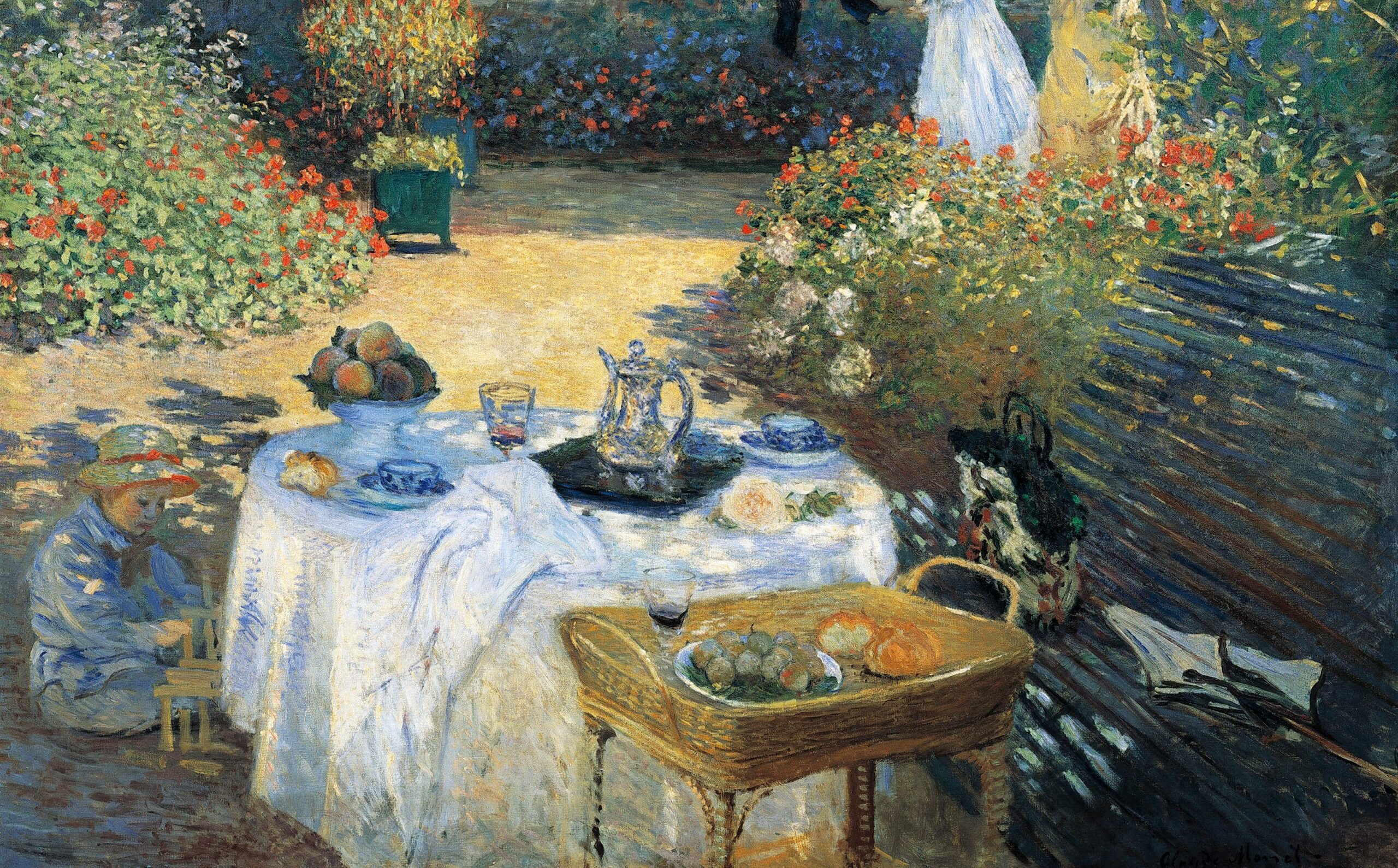
Breakfast, 1873, by Claude Monet (1840-1926). (Photo by DeAgostini/Getty Images).