By Sam Snyders
Edited by Rachel Barker and Coco Usher
In her review for The Atlantic of the 2022 revival of Jez Butterworth’s Jerusalem, Sophie Gilbert describes the play as a warning against England’s over-mythologized self-image—one of constructed narratives with little semblance to reality. For Gilbert, the play’s tension lies in the dissonance of a polity that claims “national identity without remotely invoking it in practice; to wave a flag to Edward Elgar, ingest nothing but cider and pork scratchings for eight hours, and then extravagantly throw up in a corner” (Gilbert). I seek to build upon Gilbert’s account, contending that the debased reality represented in Jerusalem has its own political contribution. This essay will approach Jerusalem from a Bakhtinian perspective, examining the play through the lens of the carnivalesque mode. The play’s opening scene, through its portrayal of substance use, its protagonist, and the affordances of its setting, can be identified as carnivalesque. These elements are further located in the carnivalesque framework in contrast to the elements of the play’s other, unseen setting, the Flintock Fair. Ultimately, these elements contribute to Jerusalem’s character as a polyphonic drama and inform the play’s commentary on the creation of national identity. Jerusalem uses the carnivalesque not simply to debase Englishness but to generate a polyphonic dramatic space that resists monologic national identity, and instead, insists that engaging with counter-cultural ideals can facilitate a stronger, more egalitarian country.
First, we must define the carnivalesque as a form and establish its political grounds. Bakhtin’s carnivalesque is “directly concerned with images of symbolic degradation and the ‘bringing down to earth’ of hegemonic values, ideas, sentiments via the evocation of a utopian community” (Gardiner 28). Utopia here refers to the creation of a space characterized by abundance and freedom. The carnival space, and therefore the carnival mode, serves as a form of social criticism by proposing an affective alternative to the entrenched malaise of modern life. In deconstructing and subverting dominant social structures—be it class, rank, age—the carnivalesque contains within it a promise of renewing society, or even humanity, as more egalitarian. As Bakhtin describes it, the carnival is “the place for working out…a new mode of interrelationship between individuals, counterposed to the all powerful socio-hierarchical relationships of noncarnival life” (Dostoevsky’s Poetics 123). The carnivalesque asserts man’s inherent universal experience by emphasizing laughter and the lower strata of culture, which is also inherent in all forms of popular, festive merriment. The effect is the deconstruction of “everything resulting from socio-hierarchical inequality or any other form of inequality among people” (Dostoevsky’s Poetics 123). For Bakhtin, disruption, and therefore change, is political because it precipitates the improvement of social structures by questioning their reification. Therefore, by employing carnivalesque elements, Jerusalem challenges notions of British identity by promoting the possibility of new or more complex interpretations of that identity, and ultimately, produces a more accommodating national society.
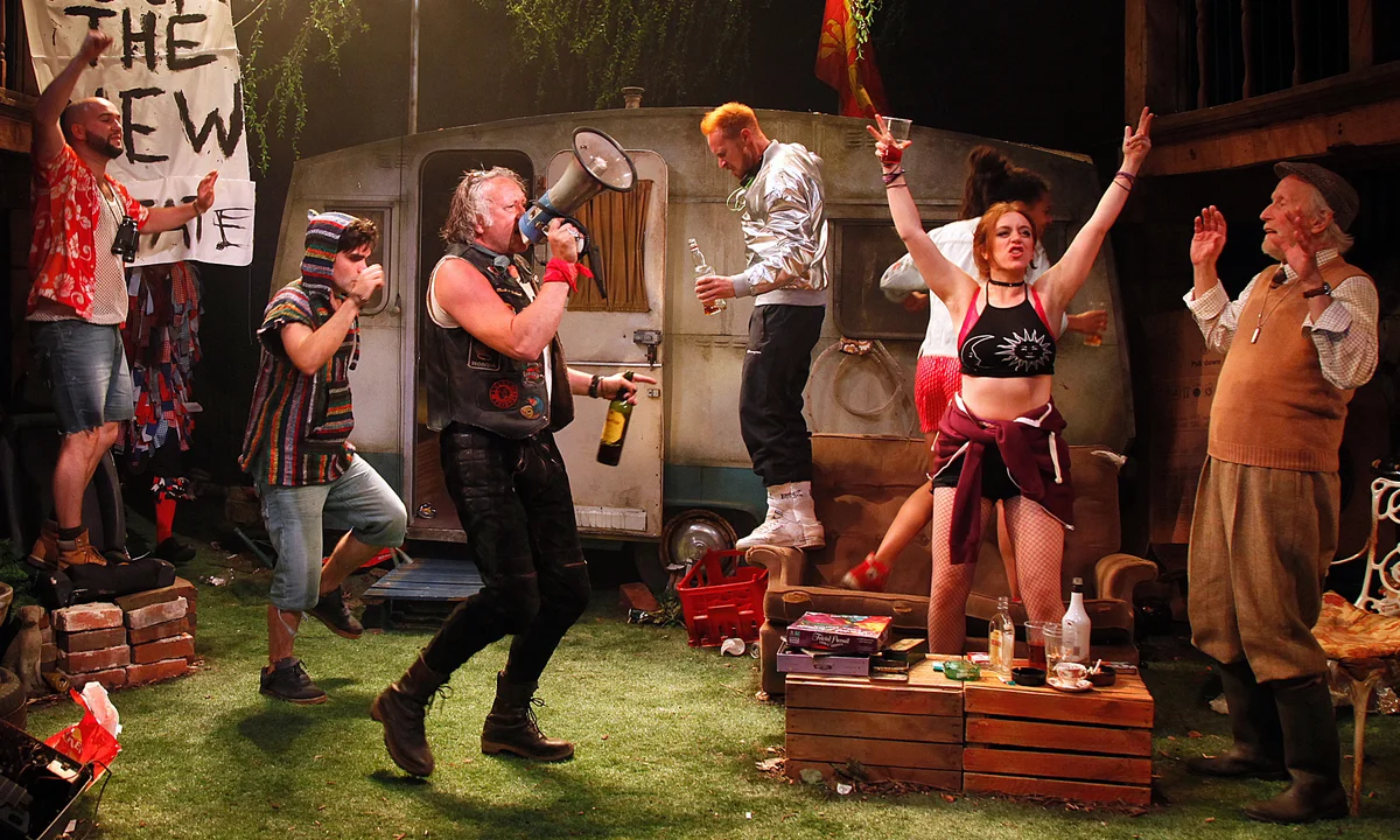
The carnivalesque permeates Jerusalem in its very first scene, where Butterworth engages with the mode by dramatizing social inversion and by breaking down the hallmarks of the British tradition. Phaedra, beneath the flag of St. George and the banner bearing the title of The English Stage Company, “curtsies to the boxes and sings, unaccompanied” (Butterworth 5). These official images of the nation frame her performance, and the mechanism of performance is altogether mannered and formal. Until Johnny Byron and his caravan interrupt Phaedra’s song with “deafening bass…from speakers on the roof” (6). Butterworth tears down a preceding dramatic performance by drowning it out with partying; order is interrupted by disorder. The party’s reckless dancing drama becomes a collision between an idealized nationhood represented in the flag and the nation’s material reality, with convention giving way to an image of “fertility, growth, and a brimming-over abundance” manifesting in “the collective ancestral body of all the people” (Bakhtin 19). Butterworth accompanies the scene with the stage direction, “people dancing wildly, with abandon,” steering the action towards a notable quality of liberation (Butterworth 6). The described wildness, the emphasis on the word abandon, and even the act of dancing alone evoke a delinking from the confines of the self informed by official society. While the scene presents an anti-normative display, it does not necessarily enact an illegitimate form of expression. Rather, the chaos witnessed may only be perceived as such because it is introduced so suddenly. By drastically shifting the formal elements, Butterworth emphasizes the power of multiplicity by upsetting these nationalistic theatrical conventions.
Bakhtin’s carnivalesque also invites an alternate interpretation of the partiers’ drunkenness. For Bakhtin, the degradation of the body is an inherent part of the carnivalesque, as it can be viewed as an apparatus of change. He posits that “to degrade is to bury, to sow, and to kill simultaneously, in order to bring forth something more and better” (Rabelais 21). Jerusalem’s depiction of bodily degradation fits within Bakhtin’s framework of grotesque realism, itself an aspect of the carnivalesque, which argues that “the grotesque body… is a body in the act of becoming. It is never finished, never completed; it is continually built, created, and builds and creates another body” (Rabelais 317). Thus, the carnivalesque is a mode of experience that is materialized bodily. Inebriation, then, can be given a positive quality, rather than an inherently negative one. Butterworth solidifies alcohol’s carnivalesque function in the play by contrasting Byron with the regulatory apparatus of the council. After Fawcett and Parsons leave the notice of eviction, Byron emerges from his trailer and exclaims, “Rooster Byron ain’t going nowhere. Happy St George’s Day,” before downing a concoction of egg, milk and a quarter bottle of vodka (Butterworth 9). The morning vodka buttresses his refusal of Kennet and Avon’s authority, combining his metaphorical rebellion with a material condition of negativity; it dismantles the notion of productively participating in society. In Byron’s reaction, Butterworth signals how drinking and drunkenness can be a political act and a political position. Byron and the partiers’ consumption of drink and drugs is a pursuit of an alternative life, a physical rejection of the norm. Cast in somewhat binary terms, sobriety is to live in a normative world, and inebriation provides access to the second world; it is a mechanism by which to live alternatively and create new social relations and meanings. Thus, Jerusalem establishes itself as a carnivalesque drama by having its principal character refuse to operate in ways deemed acceptable by English society, especially by state actors. The idealized sanctity of St. George’s day is opposed by carnivalesque inebriation that strips away the perceived inequalities between people. We can understand Byron as the carnival’s facilitator; he uses alcohol consumption to produce an egalitarian space for others at his caravan. Thus, by breaking down the expected physiological condition of the British subject, Byron models the political potential within the carnivalesque mode.
Bakhtin defines the carnivalesque mode as precipitating the “free and familiar contact among people” and an experience of equality. Carnival’s anti-categorical quality is expressed in Jerusalem through the relationship young people have to Rooster’s Wood (Dostoevsky’s Poetics 123). Whereas Wesley challenges Byron’s permissiveness regarding young people partying at the caravan, Byron counters him by declaring, “Kids love drinking. Always did. They either sit in the bus stop, shivering their bollocks off, or they go to yours, or they come here” (Butterworth 42). Pea and Tanya’s frequenting of the caravan speaks to the freedom it affords them. Regarding Byron’s parties, Pea and Tanya exuberantly declare “fucking immense. Non-stop, front-to-back, Al class” (Butterworth 26). Its peripheral nature offers them a respite that they might not otherwise receive. It is that emancipation that propels them to try and protect it with gnomes and bedsheet signs saying “‘FUCK OFF KENNET AND AVON’” (Butterworth 47). The protectiveness that Pea, Tanya, Ginger, Davey, and Lee have over the caravan and the wood speaks to it as a special place. It is a carnivalesque locale: a physical, spatial manifestation of the “second world” within the drama’s larger social framework. There is, of course, a competing vision of revelry in the drama, which is characterized as antithetical to the carnivalesque nature of Byron’s parties and the woods. If Rooster’s Wood is a space of openness and transformation, then the Flintock Fair is one of conservatism.
The carnivalesque of Byron’s caravan is further reinforced in the contrast between it and the Flintock Fair. Ginger’s description of the fair situates it within the binary between carnival and the rituals of official life. The fair is a municipally sanctioned event replete with “Trestle tables. Hot-dog vans … Bunting. Bumper cars. Whirler-swirler. Floats” (Butterworth 19). While the Flintock Fair proposes the idea of festivities, it is not truly carnivalesque in nature. Whereas carnival is an event dominated by the lower classes, official feasts, “whether ecclesiastical, feudal, or sponsored by the state, did not lead people out of the world order and created no second life” (Rabelais 9). By making the feast an official event, the organizing body—in Jerusalem’s case, the council—strips the event of its transformative potential. Instead, it merely reinforces the existing structures of life. Ginger’s recitation of its schedule explicates the event’s rigidity: “10 a.m., The Flintock Men – outside The Cooper’s Arms. 11 a.m., Floats. 11.30, Ploughing competition. 11.45, Bell-ringing. 1-2o’clock, Donkey drop. 12.15, Yoga demonstration. 12.30, Wheelbeero race. 12.45, Dancing dog display. 1 p.m., Knobbly knees…” (Butterworth 46). The fair’s schedule firmly characterizes it as an official feast, establishing a formal link to a time that counters “the uninterrupted flow of time” experienced in the carnival crowd (Rabelais 92). The fair’s rigid fifteen-minute intervals discourage spontaneous interaction among its participants; instead, they mimic the scheduled conditions of the workday and demand control, aligning the fair with capitalism and the state.
There is also the issue of the carnival’s eradication of rank, which the Flintock Fair works against. Bakhtin notes that during official feasts, “everyone was expected to appear in the full regalia of his calling, rank, and merits and to take the place corresponding to his position. It was a consecration of inequality” (Rabelais 10). Conversely, the carnivalesque is marked by “the suspension of all hierarchical rank, privileges, norms, and prohibitions” (Rabelais 10). Moreover, while Wesley, drunk, recounts to Byron how “the Mayor is in the stocks outside The Moonrakers, and kids are chucking sponges at him,” this is not a genuine hierarchical suspension (Butterworth 92). It is because the Mayor still holds power that throwing sponges at him has become an activity. He willingly participates in his capacity as an authority, thereby affirming the importance of rank. Hierarchy is, if anything, made clearer by this event because it is a symbol of the Mayor’s continued importance during the festivities: he and his wife both deliver formal speeches (Butterworth 46l, 104). The sponge-throwing does not permit free association, but affirms the norm; thus, the Mayor’s position is reinforced through the fair, rather than disrupted by it. On the whole, then, Jerusalem’s contemporary Flintock Fair is a mere co-option of its predecessor, and, though it claims an air of festivity, it offers its participants limited or no liberation.
The contrast between Rooster’s carnival at the caravan and the official feast of the Flintock Fair unsettles a singular understanding of Englishness. The divergence in the spirit of their activities is an issue of cause and effect. Though we learn that “twenty year back, Johnny Byron was the Flintock Fair,” Ginger explains that after a motorcycle jump accident, “council stepped in. Made daredevilling illegal” (Butterworth 30, 32). The assumption is that had the council not interfered, Rooster would have continued to jump motorcycles, and as a consequence, the fair became less attuned to its audience and less thrilling. As time passes after his accident, the “main attraction on Fair Day’s some twat in a tent doing snooker trick-shots. Balloon animals. Smarty fucking arty” (Butterworth 32). What Butterworth embeds in Jerusalem’s chronology, however, is a timeline of Byron’s metaphorical and literal exile from the town. Byron’s accident, where he “skidded on the ramp and flies through the air and he hits this one truck doing about eighty mile an hour,” occurred in 1981 (31). Fawcett informs Byron that his “illegal encampment has passed unchallenged since September 1982” (95). Hence, the town’s rejection of daredevilry, the heart of the Flintock festivities, spurred Byron to establish his residence at the caravan. By repressing Byron and his means of expression, the municipality diminished the fair as an event of abundance, and so too bolstered Byron’s disruptive behaviour; he took the true carnival with him. Recontextualized in this way, the eviction notice is not just an administrative mechanism but a culmination of attempts to dismantle “the world of ideals” that Byron created through his illicit partying (Rabelais 9). In this chronology, Butterworth considers the consequences of a restrictive society. Evicting Byron does not rid society of him, but pushes his practice elsewhere; Jerusalem indicates that escapism and counter-cultural expression are both inherent and inevitable in any society. The national character, then, cannot be understood as homogeneous, and inclusive of contrary attitudes and perspectives.
As such, the play houses a multiplicity of perspectives and voices that maintain a sense of autonomy, rather than being merged into a unitary conception of England. In this sense, we can understand Jerusalem as having a polyphonic character. Bakhtin describes a polyphonic text as containing “a plurality of independent and unmerged voices and consciousnesses” (Dostoevsky’s Poetics 6). Carnival, due to its subversiveness and emphasis on free association, brings together competing voices and prioritizes the unofficial voice; thus, the play refuses ideological closure, instead prioritizing rupture and difference. In Jerusalem, the carnivalesque is a site of tension between competing visions of England. For instance, the legitimacy of Byron’s encampment divides many of the characters: Byron himself is stalwart, Fawcett and Pollock wholly oppositional, and figures like Wesley and Davey bring nuance. Byron utilizes a certain language of nostalgic sovereignty at the play’s outset, issuing commands with “Right, you lot. Hear ye, ’cause I just passed a new law…” (Butterworth 29). Davey, however, contests Byron’s legitimacy by arguing that the petitioners have “a point, though,” and subsequently invokes the rights of private ownership by recognizing no one would want “some ogre living in the wood” (Butterworth 30). Accordingly, Butterworth has constructed Jerusalem to bring together these heterogeneous voices, rather than as a vessel for any definitive account of the state of England. In fact, Butterworth has been adamant that Jerusalem is not a diagnosis of the nation (Gilbert). He does not reconcile these oppositional voices, but writes them to maintain or insist upon their own validity.
Butterworth resists valorizing any single voice, especially Byron’s. Though the play focuses on Rooster, his relationships with the other characters sustain the drama’s ambivalence and, therefore, its ability to host conflicting voices. If we are to understand the quality of polyphony as being the “organized coexistence and interaction of spiritual diversity, not stages in the evolution of a unified spirit,” then Byron and the carnivalesque mode entrench such diversity in Jerusalem (Dostoevsky’s Poetics 31). Inasmuch as the carnivalesque challenges hierarchy, so too will traditional social structures attempt to reassert themselves, including idealized familial roles. Thus, Byron’s relationship to Dawn and his son, Marky, exhibits the impossibility of defining oneself through a single mode of being. He is all at once Rooster, the carnival king, daredevil, storyteller, and a drunk, absentee father. Those competing visions are brought together in one persona, and rather than flattened, are coalesced. In considering the carnivalesque, although its disruption has generative political implications, its means can also be interpreted as antagonistic or improper. Regardless, Jerusalem refuses to simplify the ontologies it presents. Rather, there is an opportunity for productive interpretation and discourse in representing both the normative and the subversive.
Butterworth ultimately leaves the play’s main conflict, Byron’s fate, unresolved; the audience is left with an interpretive, rather than didactic, image. If dialogic interaction derived from polyphony reveals that “truth is not born nor is it to be found inside the head of an individual person; it is born between people collectively searching for truth,” then the audience’s interpretive work regarding Jerusalem demands recognition (Dostoevsky’s Poetics 110). At the play’s end, despite the assurance that he will be forcefully removed from the wood, despite being physically brutalized and isolated from his friendships, Byron refuses to capitulate to social and legal antagonism. Instead, he bellows a curse, and beckons the giants of myth to “Rise up! Rise up…Come, you drunken spirits. Come, you battalions. You fields of ghosts who walk these green plains still. Come, you giants!” once again insisting upon the validity of his claims and perspective (Butterworth 109). He is bloodied, grotesquely beaten, but refuses to capitulate. The final image, of Byron relentlessly beating on his magic drum, proposes not closure, but possibility. This refusal is not a wholesale confirmation of his actions, but neither can it be understood as a feeble protest to the machinations of the state. Butterworth leaves the audience with a final image of multiplicity, dangling before them a revelation of Byron’s true nature and the validity of his convictions, yet frustrating its actualization. Thus, the ambiguity of Jerusalem’s ending gestures towards its greater meditation on change and transformation. The play’s development of action occurred without allowing anyone’s vision of life to dominate. Were Butterworth to over-moralize either the conservative or transgressive politics at the heart of its narrative, it would defeat, in the audience, the consideration that he seems to believe is so vital.
Gilbert’s response to the activities and characters presented in Jerusalem was rightly oriented towards an investigation of Englishness. Yet, her account leaves less room for the vitality by which Butterworth animates Byron’s world, or for his refusal to unify the play’s action under a single, moralistic concept of nationhood. Approaching Jerusalem with the carnivalesque animates its seemingly debased elements not as simple degradations, but as disruptions. Squatting, drunkenness, partying, loud music, and ingesting “nothing but cider and pork scratchings for eight hours” (Gilbert) are not in themselves failures of the national character, but remain a part of the landscape that Jerusalem confronts—and a part of the critical evaluation at the heart of her article. Butterworth refuses to outright dismiss Byron and his band of misfits, but he does not sanctify them either. The carnivalesque creates space for “liberation from the prevailing truth and from the established order,” which in turn gives rise to new interpretations of that order (Bakhtin 10). That critics like Gilbert struggle with rectifying this image of England with their own is what gives Jerusalem its dramatic potency. To bring together and suspend competing voices in a drama emulates the carnival’s interaction between perspectives. In representing conflicting visions of Englishness, Jerusalem invites the possibility of a renewed, perhaps even better, conception of national identity—pork scratchings and all.
Works Cited
Bakhtin, Michail Michajlovič. Rabelais and His World. Translated by Hélène Iswolsky, First Midland Book Edition, Indiana University Press, 1984.
—. Problems of Dostoevsky’s Poetics. First edition. University of Minnesota Press, 1984. Project MUSE, https://muse.jhu.edu/book/58371.
Butterworth, Jez. Jerusalem. Nick Hern Books, 2009.
Gardiner, Michael. “Bakhtin’s Carnival: Utopia as Critique.” Utopian Studies, vol. 3, no. 2, 1992, pp. 21–49. JSTOR, http://www.jstor.org/stable/20719133.
Gilbert, Sophie. “The Problem of English Identity.” The Atlantic, 14 June 2022, https://www.theatlantic.com/culture/archive/2022/06/jerusalem-play-london-west-end-revival/661253/.
Feature Photo
Shakes the ground beneath our feet … Jerusalem at the Watermill. Photograph: Philip Tull