By Nina Tang Yun Sing
Edited by Meera Pande and Rachel Barker
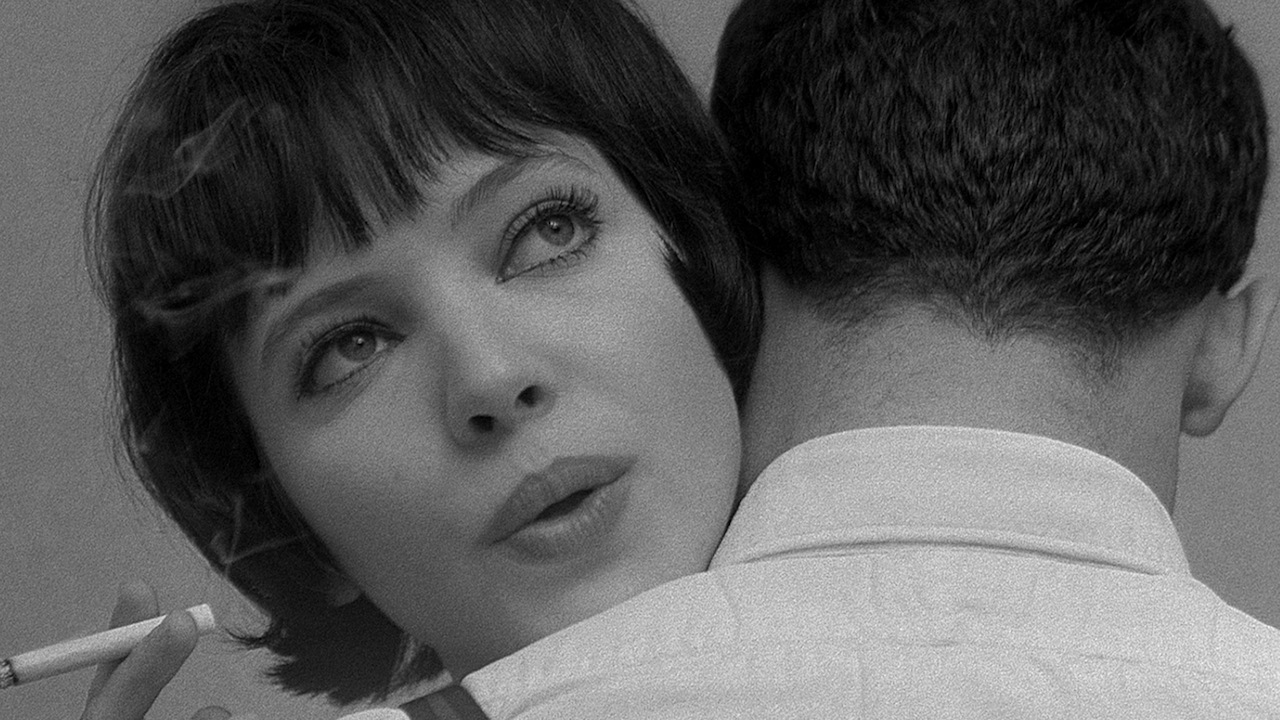
Object or subject? A woman swings endlessly between both realms, never fully landing in either. In his film, Vivre sa vie (1962), Jean-Luc Godard questions the very possibility of female agency under patriarchy. Dissolving the line between objectivity and subjectivity, Godard challenges the viewer’s ability to distinguish where the protagonist, Nana, truly stands. Our understanding of ‘subjectivity’ can largely be attributed to Laura Mulvey’s Visual Pleasure and Narrative Cinema, in which she argues that a woman is “tied to her place as bearer of meaning, not maker of meaning,” excluded from narrative control and symbolic authority (7). As she is stripped of the power to produce meaning, what is she left with? Mulvey describes this bareness as “to-be-looked-at-ness…displayed as sexual object” (11). Thus, although Nana’s spontaneous dance should be an instance spotlighting her bounding energy, Godard perpetually undermines her agency as elusive, asserting how her gestures are misread as autonomy and her presence mistaken for power. Through Brechtian distancing, visual obstruction and paradoxical symbols, Godard folds her moment of resistance seamlessly back into the very mechanisms that objectify her.
In Chapter 9 of Vivre sa vie, one of the film’s twelve episodic tableaux, Nana selects a song from the jukebox and begins to dance alone, entering what is arguably her most expressive and euphoric moment in the film. She stands inside a dimly lit café, enclosed by dark walls with a pool table at the centre of the checkered floor. As the music commences, she perks up, swaying and swinging, attempting to connect with the men across from her. Yet, her energy is met with nothing but the dimness of silence and indifference. Throughout a significant portion of the film, Godard’s camera moves first, with Nana following in its wake. However, this sequence presents the inverse. Is this where our heroine finally asserts control over her actions? As hopes soar with her first deliberate movement, holding the camera on a leash, Godard crushes them within the blink of an eye. As Nana heads towards the jukebox, she is framed in a medium shot, facing away from the camera, her figure partially obscured by a pillar. This seemingly minor detail upholds Godard’s determination to never grant Nana full autonomy, even in a moment seemingly driven by her own will. He mocks Nana for trying to outrun his camera by denying her full exposure.
The jukebox acts as a paradoxical symbol of Nana’s gradual transformation from subject to object. On the surface, it is a tool of autonomy which Nana chooses to activate, displaying a small but significant degree of agency in an environment where her actions are otherwise dictated by others. By this point in Vivre sa vie, Nana has entered sex work, a system where she is fully reduced to the status of object; her body, time, and movements are constantly regulated by the male pimps and clients who desire her body. Thus, even the subtle choice of selecting a song on the jukebox becomes an act of power for a body that is so often used by others, rendered a hollow shell when left to itself. However, only offering a preset selection unveils her ‘agency’ as a facade, an illusion of choice. The machine’s predetermined options mirror how her journey to prostitution was inescapable, a road designed by Godard himself. As the song begins to play, the camera slowly tilts upward over Nana’s body, mimicking a voyeuristic surveillance camera. Despite the opportunity to capture her flirtatious glance with a close-up, Godard persistently refrains from such intimacy. As noted in a case study of Vivre sa vie, “Brecht developed his ‘distancing’ or ‘alienation’ effects” to challenge passive spectatorship and provoke active criticism, a technique Godard utilizes to turn his audience against Nana, prompting them to question rather than empathize (Component 2 Case). Consistently maintaining visual distance between Nana and the audience, Godard uses verfremdungseffekt, “a theatrical technique aimed at preventing the audience from becoming overly emotionally involved with characters” and instead prompting the viewer to be critical of her (Ungvarsky). This technique is equally reflected at the beginning of the sequence when we are given only a partial shot of her back. While the sequence momentarily resembles a musical, the lighting remains perpetually soft and dim throughout. Rather than embracing theatrical conventions such as celebrating the protagonist with a spotlight, the subdued lighting mirrors the muted emotional response of the men around her. In keeping with Brechtian techniques, Godard persistently isolates her from both worlds, in and out of the film, discouraging the viewers from feeling sympathy for Nana.
To an extent, Nana’s joyous spontaneity still holds a flicker of power. As she begins to dance, the camera seems to awaken, shifting from rigid to fluid movement, capturing her sense of freedom and euphoria. Her dance becomes a form of resistance against and within Godard’s constraints. Breaking the camera’s stiffness, Nana attempts to break through patriarchy’s walls, briefly reclaiming subjectivity even as she remains trapped within the very system that objectifies her. Circling the pool table, a symbolic gameboard governed by rules and logic, her frivolity clashes with its connotations of calculated control. She does not partake in the game but moves around it, refusing to abide by the structure that oppresses her. Yet the game does not stop. Just like the world Godard has constructed, it remains a system dictated by fixed rules and predetermined outcomes, where objects are intentionally moved by external forces. Nana is merely a striped ball, not a participant but an object to be pushed and redirected by others. This prop evokes a strong sense of determinism, reflecting how even in her most alive, individualistic moment, she is ultimately controlled and overpowered by the forces that seek to silence her. It is a reminder that she does not truly have free will, only the illusion of it.
While Nana’s dance acts as a physical soliloquy, a form of resistance against her oppression, it remains a non-verbal form of communication. Godard’s use of Brechtian alienation is central to the dance sequence, shaping not only how Nana is seen but also how she is denied access to subjectivity. Nana’s lack of speech is not random, but a form of removal from the world around her, a testament to her isolation from it. In Nana’s vibrant burst of emotion, which should have reconquered her status of subjectivity, only her body and sensuality are given power, reinforcing her permanent objectification. Within this seemingly liberating moment, the film offers a glimpse of the sequence from Nana’s point of view. On the surface, this shift might suggest an effort to center her subjectivity, to momentarily allow the audience to see the world through her eyes. Yet the camera’s long and slow panning of the room, misaligned with her dynamic movement, feels idle. Rather than matching her vitality, the camera’s lethargic flow depicts Nana’s viewpoint as uninteresting and redundant. The effect is not one of empowerment but of erasure. Her point of view offers a gliding medium shot of the two pimps, glaring at her in disgust. Their eyes look her up and down, scanning her body and movement with judgment rather than desire. There is no recognition of the joy and life she emanates; their gaze simply evaluates her body. And just like that, without a word of acknowledgement, she is dismissed. She may move freely and the camera might pretend to adopt her gaze, but the world she inhabits will persistently look through her, as though she were never there. By distancing Nana from the audience and denying access to her thoughts or desires, Godard compels the viewer to fill that void by projecting meaning onto her silence and gestures themselves, guided only by the indifferent gazes of the men around her.
As the music swells, Nana begins to dance with greater intention, aligning her movements with the faster beat of the music as she glides across the cafe floor. At one point, she swings around the pillar that had previously obscured her. This subtle but significant gesture carries clear symbolic weight. By emerging from behind the obstruction, Nana momentarily reasserts her presence, and with it her agency, in a space where her visibility had previously been diminished. Failing to engage any of the three men, their lack of reciprocity and stillness underscore the emotional and social distance that separates her from the world around her. Thus, through her attempt to connect with the musicality of the song and her surroundings through the pillar itself, Godard conveys her desire to participate in something collective whilst emphasizing her isolation. The viewer is reminded that her gestures of individuality exist in a space that refuses to see or respond to her.
A wide shot of Nana by the pool table captures her last attempt to allure the man as she stretches out her hand to him, only to withdraw it instantly, folding the gesture seamlessly into her dance as though the moment had never occurred. Emphasizing her smallness, the wide frame reinforces her isolation, creating the illusion that she is emotionally and spatially distant from those around her. Her agency is performative and not transformative, visible but ultimately inconsequential. While Nana may act as a subject through her movement, she is fixed as an object through what Mulvey coins the ‘male gaze’ as Nana “holds the look, plays to and signifies male desire” (11). As the sequence draws to a close, Nana comes to rest and holds onto the pillar. The pillar takes on a new, unsettling association as it visually and thematically echoes a stripper pole. As this image foreshadows her inevitable descent into sex work, her entire dance, initially a form of resistance against the structures that oppressed her, eventually leads her back to her fate. Furthermore, the music ends with the repeating refrain “Swing, swing, swing”; although the seemingly light words connote a sense of freedom whilst their rhythm matches Nana’s carefree movement, there is a lurking irony to the words. The singer is almost mocking, commanding Nana to be free when she can never truly be. While the words, “Swing, swing, swing,” suggest freedom, “swinging” also carries a sexual connotation, commonly associated with promiscuity and non-monogamous exchange. What sounds playful and light-hearted becomes a coded reminder of how Nana’s movement and sexuality will be interpreted by the patriarchal world around her. The singer’s refrain thus feels less like celebration than mockery, commanding Nana toward a liberation she can never truly access.
Vivre sa vie offers no resolution, no redemption. The world Godard has constructed is relentlessly merciless, leaving us with the lingering image of a woman who dances not towards liberation, but endlessly in circles. In the end, Godard does not present one world, but two. The visible world observes Nana with indifference, whilst the camera’s lenses imprison and alienate her from the other. She twirls alone, her agency redundant. Godard derisively bequeaths her with a false sense of control, which she can exert on nothing and no one. Holding the strings tightly, Godard the puppeteer jeers, “Swing, swing, swing” as he watches her spin within the hollow sphere. All she can do is swing, rhythmically, endlessly, within a system that refuses to let her be anything more than an image.
Works Cited
COMPONENT 2 Case Study: Vivre sa Vie/ My Life to Live (Godard, 1962). WJEC CBAC, resource.download.wjec.co.uk/vtc/2017-18/17-18_3-12/vivre-sa-vie-teacher-resource.pdf.
Godard, Jean-Luc. “Vivre sa vie: Film en douze tableaux.” Kanopy, www.kanopy.com/en/mcgill/watch/video/113397.
Mulvey, Laura. “Visual Pleasure and Narrative Cinema.” Screen, vol. 16, no. 3, 1 Oct. 1975, pp. 6–18, https://doi.org/10.1093/screen/16.3.6.
Ungvarsky, Janine. “Distancing effect (alienation effect)”” EBSCO, 2024, www.ebsco.com/research-starters/drama-and-theater-arts/distancing-effect-alienation-effect.
Feature Photo
Godard, Jean-Luc. Vivre sa vie. Union Film Distributors Inc., 1962.