By Maia R. Becerra
Edited by Lydia Lepki and Kristina Tham
Within the tradition of Christian mysticism, the body and soul overlap in the spiritual realm. The body becomes the epicenter for the development and exploration of a relationship with divinity, while faith and practice feed the soul. The experiences of mystics across the Catholic tradition are heavily grounded in the body; the sensorial, the tactile, and the physical are demonstrations of God’s existence, and more importantly, of his presence and personal relationship with the believer. El Libro de la Vida (The Book of Her Life), written by sixteenth-century Spanish nun, mystic, and doctor of the Church, Santa Teresa de Ávila, recounts her close interactions with divinity through extremely sensorially-charged mystic visions, where Christ would touch her, speak to her, hold her, and sometimes give her tests of faith. Through this text, Teresa de Ávila expresses her beliefs and frameworks for cultivating a tangible relationship with the divine, and the importance of physicality and understanding one’s body as parallel to that of Jesus. Her book evidences that the body of the female mystic is a space for building systems of knowledge through the embrace of women’s subjectivity and their creation of a sense of self within oppressive and patriarchal hierarchies, such as the Catholic Church. Since the body of the female mystic finds itself reflected materially and spiritually in Christ, a new subjectivity is formed through the acts committed and felt by the mystic body when in the presence of the divine.
Santa Teresa de Ávila, also known by her followers as Santa Teresa de Jesús due to her spiritual marriage to Jesus, was born in Ávila, Spain, in 1515. As one of the most literarily prolific and recognized mystics in the Catholic Church, she wrote extensive collections of her meditations, theological understandings, and poetry, all dedicated to exploring her encounters with the divine. Her literary practice is heavily grounded in the sensations she experienced while in religious ecstasy, often described in great detail that draws on erotic language. The degree to which Teresa de Ávila’s experiences relied on emotions caused by physical pain, ecstasy, confusion and corporeal interactions with the divine, depends on the notion of her body as a vessel through which her theological knowledge is acquired. Labelling her literary practice as one that describes erotic acts is heavily debated within the canon, particularly because Teresa de Ávila acknowledges the limitations of language when attempting to depict interactions with the divine, implying that while erotic language is the closest linguistic proxy, it does not capture the real nature of their relationship.
In order to understand Teresa de Ávila’s personalrelationship with Christ, it is imperative to acknowledge the emphasis on the physicality of the crucified Christ, a cornerstone of the Catholic tradition since the thirteenth century. Amy Hollywood addresses the development of the physicality of Christ in Catholic imagery in the essay “That Glorious Slit,” stating that texts and images on Christ’s life, death, and suffering became increasingly important narratives for the laity to follow in an attempt to understand salvation (Hollywood 174). These texts sought to evoke emotional responses in the believer through the humanization of Christ. In graphic and sometimes violent depictions of the Crucifixion and The Passion in general, Jesus becomes a bridge between humanity and God, life and death, sacrality and mortality. This focus on the body of Christ is also a consequence of the belief in transubstantiation (Christ’s body being physically transformed into bread and wine during communion) and the idea of his metaphorical physical presence during Mass. Hence, the importance of this humanization goes beyond relatability; recognizing Jesus’ suffering as expiatory transformed the possibility of spiritual redemption into a redemption of the body. This practice of humanizing Christ’s suffering, known as affective piety, was prominent throughout the history of the Catholic tradition, particularly in the Middle Ages and the beginning of the fifteenth century. Affective piety allowed believers to understand Christ as both human and divine, while believing his death was a sacrifice for humankind that requires believers to suffer alongside him. Seeing one’s pain reflected in that of the Saviour, and vice versa, meant that salvation was possible within one’s sorrow, and that human despair could have a greater purpose. Requited suffering created a reciprocal relationship with Christ, made possible through Imitatio Christi: the idea that all Christians must seek to imitate Christ in their everyday lives (Flynn 258). Yet, with imitation comes identification, building the aforementioned idea of Christ’s suffering as a relatable and desirable endeavor.
This physical aspect of belief and practices surrounding Christ prevailed in the sixteenth century mainly through meditations. Although less tactile than those in the Middle Ages, these meditations still centered around the idea of visualizing Christ’s often-wounded body, and finding solace and companionship in its image. In El Libro de la Vida, Teresa de Ávila states that the corporeality of Christ through religious visions was something that escaped reason, which only the soul and body could perceive (Teresa de Jesús 9; my trans). She writes that in her visions she would often attempt to understand or grasp the corporeality of Christ to no avail: “And to see that he was speaking to me and I stared at that great beauty and the softness that he spoke those words with, that beautiful and divine mouth […] and wish extremely to comprehend the color of his eyes or his height” (Teresa de Jesús 2; my trans.). The beauty and greatness of Christ surpasses any physical imagery that Teresa de Ávila could describe through language, leading to a more subjective and sensory-focused perception of his corporalization. In Julia Gatta’s “Mysticism and Incarnation,” she posits that Teresa’s belief in the Incarnation (the notion that God placed Jesus within a “human” flesh, making him the ideal reconciliation of mortality and divinity) marked the way of her spiritual path (Gatta 259). That is to say, Teresa’s core beliefs rely on the humanization and corporealization of Jesus as a conduit to religious illumination and divine understanding.
This corporeality is made present in Teresa de Ávila’s physical sensations of not only visualization and pleasure but also pain. She describes visions of a mostly wounded Christ, where “in tribulation he would show me his sores, sometimes the cross […] always in glorified flesh” (Teresa de Jesús 8; my trans.). His experience runs parallel to Teresa de Ávila’s own depictions of her spiritual and physical sorrow when in a trance. This visualization of a suffering Christ was often accompanied with an understanding of Christ’s Passion as a demonstration of availability for humanity, and a “disdain for dignity and self-protection” (Gatta 261) which mirrors the willingness of the mystic to be at the physical and spiritual mercy of the divine, regardless of the painful consequences this might elicit (de Beauvoir 711). Through this, a sense of affective piety emerges where Teresa de Ávila begins to perceive Jesus as seeking her out as much as she seeks him—a belief that allows for the intimate relationship between them to develop, where the pain of Christ is translated into Teresa de Ávila’s painful yearning for him. This pain blurs the line between pleasure and grief. Teresa de Ávila says she “saw [her]self die with a desire to see God. […] [she] had these great impulses of love, […] that left [her] without knowing what to do, for nothing satisfied [her], nothing fit in [her], it truly seemed to [her] like he was ripping [her] soul out” (Teresa de Jesús 8; my trans.). This development of a personal relationship where pain and suffering are both the basis and consequence of unconditional love leads to the need for incarnation and physicality to develop a joint subjectivity. Through the physical and sensorial experiences of the mystic’s body, an idea of companionship instead of subservience arises, subverting not only the gendered but also the religious hierarchies within the Catholic church.
The equality of pain and pleasure was a frequently experienced dichotomy within the mystic tradition. Teresa de Ávila describes her pain as something to be “savoured,” and as a source for spiritual perfection (Teresa de Jesús 10; my trans.). In Maureen Flynn’s “Spiritual Uses of Pain in Spanish Mysticism,” she states that interactions with God were “not achieved by escaping the demands of the flesh but by the very means of the flesh. Divine transcendence took place within and through sensations of the body” (Flynn 160). As has been established in the case study of Teresa de Ávila, her visions were mostly filled with physical phenomena or emotional and spiritual sensations that became physical because of their intensity. This leads to the perception of suffering as a way of amplifying the sensations of the body in order to achieve ecstasy (Flynn 272). The mystic seeks not to evade pain through the grace of God, but to feel pain as a sign from God. Pain becomes the signifier for divinity within a body that would otherwise be intact. This is seen throughout the Catholic mystic tradition in the appearance of stigmata or lacerations on the bodies of otherwise “healthy” saints and mystics. The connection between the body and the soul requires a sense of identity that can then place itself on a spiritual and physical level with Christ, by seeing oneself as a subject not only deserving of salvation, but also of communication with the divine: mystics then require an awareness of the importance of their bodies and the sensations they encounter (such as pain and pleasure) as experiences that transcend the physical into the spiritual. The creation of new theological understandings through the body of the mystic opens the door for the acquisition of knowledge on the divine, and of religious practices that were usually reserved for high figures in the clergy only, presenting mystics with a personal window into the teachings of the church that are commonly reserved to priesthood and serve to maintain a hierarchical order within these institutions. In the case of Teresa de Ávila, this knowledge demonstrated the inherent interiority within human beings: a space within the self that allowed for spiritual transcendence to occur through a dialogue with God (Bosco de Jesús 6; my trans.). Teresa de Ávila believed in the possibility of transcendence through discipline in prayer and aceticism, yet, while maintaining love and a belief in one’s own personal possibility for salvation at the forefront of the relationship with the sacred.
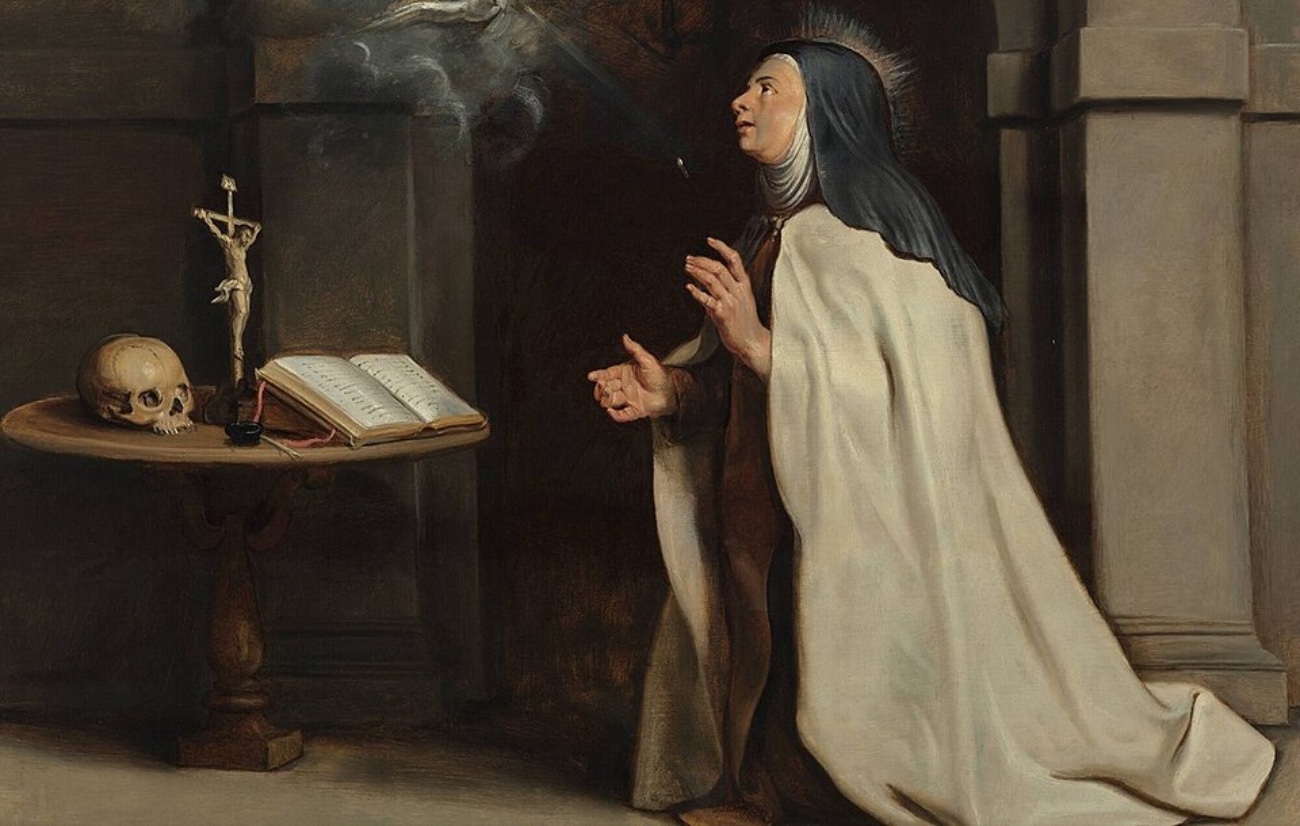
In bridging the connection between the body, suffering, ecstasy, and a personal relationship with the divine, I will now explore Teresa de Ávila’s account of her Transverberation: a painfully ecstatic vision in which she was repeatedly pierced by a Cherub’s fiery arrow. The account of Transverberation in this chapter is the most elucidating example in Teresa de Ávila’s writing on the intertwined nature of the physical body and the soul. She states that the Cherub pierced her in the heart several times, reaching her entrails:
When he drew it out, it seemed it took my insides with it, and left me ablaze in a great love for God. The pain was so great that it made me moan, and so excessive was the softness that put me in this great pain, that there is no desire for it to go away. […] It is not a physical but a spiritual pain, although the body is still involved plenty. It is an exchange so soft that happens between the soul and God (Teresa de Jesús 13; my trans.).
Here, Teresa experiences an extremely rich sensorial ecstasy that requires erotic language to convey the intensity and violence of the piercing by the angel—a violence that becomes physically pleasurable because of the sacrality of its perpetrator: the divine. In her chapter on mysticism in The Second Sex, Simone de Beauvoir writes that the erotization of the Transverberation is a consequence of the “poverty of language,” where Teresa de Ávila must borrow vocabulary from eroticism as an approximation to the extremely subjective experience of being touched by the sacred (de Beauvoir 712). The spiritual pain (and pleasure) Teresa de Ávila felt could only be put into words that would make sense to her and to humanity by binding together the corporeal and the spiritual. De Beauvoir states that human love can function as a vehicle towards transcendence just as much as divine love, for they bleed into each other when there is a point of contact between humanity and God (de Beauvoir 709). For Teresa de Ávila, this intervention between the human and the divine through the experience of Transverberation is not only an affirmation of her vocation and her worthiness of being in contact with sacrality, but also a reaffirmation of her subjectivity as a person to be chosen to have a personal relationship with Christ. The intervention acts as the baseline for Teresian theology where transcendence and dialogue between the divine and the human is possible and achievable for any person who seeks it, and is willing to deliver themselves to God in body and in spirit. De Beauvoir further argues that this relationship is only plausible because of the human traits ascribed to Christ within the Catholic tradition, making a point for the importance of affective piety when considering the experiences of female mystics (de Beauvoir 709).
The case study of Teresa de Ávila’s El Libro de la Vida provides insight into the idea of the female mystic’s body as an unorthodox “other” space for the creation of knowledge from personal experience and sensorial practices rather than doctrinal and social teachings. In “The Mystic Poet: Identity Formation, Deformation and Reformation,” Amanda Michaels writes that mysticism is a grey area where deconstruction of the interior spaces can happen; the mystic body is a body of open-ended interpretation (Michaels 66). This is an element starkly present in Teresa’s writings, in the form of a willingness to question the self to break down abstract understandings of what divinity entails and, instead, place them together to form a tangible notion of what union with God means. For instance, Teresa de Ávila denies the assumptions made by her confessor and the clergy regarding the nature of her visions being demonic; she states that although she attempted not to contradict them and to obey their commands, her body and mind were convinced of the divine nature of these visions (Teresa de Jesús 4-5; my trans.). Michaels further argues that mysticism becomes a reclamation of the female body, which happens through the subversion of the “natural” or biological position of women as the innate opposite of the trinity, which can also be applied to the inherently male-led hierarchical order of the clergy (Michaels 674). In chapter twenty-nine, Teresa de Ávila clearly wishes to understand the nature of her visions based on her experiences, as well as her personal and theological knowledge, rather than following the advice or orders of the clergy blindly. She writes that she “begged God to free [her] from being deceived,” both by her visions and by the insistence on demonic possession from the clergy, expressing how subversion of authorities, whether clerical or social, requires embracing a new, corporeal communication with the divine (Teresa de Jesús 5; my trans.).
Moreover, in “Los Espacios Otros” (The Othered Spaces) María José de la Pascua Sánchez maintains the argument that the alteration of the “natural order” by building new systems of knowledge, theological or otherwise, is inherent to the use of the female body as a tool to project other possible subjectivities (de la Pascua Sánchez 5; my trans.). The female mystic body thus becomes a space through which a reclamation of the subservient, wounded, and “imperfect” body can become a source for the development of knowledge systems that threaten doctrinal patriarchal teachings. De la Pascua Sánchez emphasizes how historically, women’s bodies that opposed the sexual and reproductive order—nuns, for instance—developed a problematized sense of self that allowed them to create spaces for the pursuit of knowledge and understanding within themselves (de la Pascua Sánchez 7; my trans.). The body becomes the only place through which the mystic woman can legitimize her knowledge, because this knowledge is based on sensation-driven experience that cannot be denied. Teresa de Ávila’s emphasis on the Incarnation, the physicality of Jesus, and the sensorially-inclined visions that she describes, form the development of a theology of the body that is reciprocal between the devotee and the divine instead of unilateral affective piety, bringing her closer than many to something like a personal relationship with the sacred.
The importance of looking at Teresa de Ávila contemporarily lies in her groundbreaking subversion of how theological knowledge can be acquired. She existed as a subject that recognized her interiority and possibilities for transcendence despite the oppressive clerical and gendered hierarchies that surrounded her. Teresa de Ávila’s exploration of pleasure, pain, and ecstasy through a mystical lens allowed her to understand her physical body as directly in contact with the divine, appropriating the humanity of the figure of Christ not only as a source of solace, but also as an epicenter for hope and devotion. Teresa embodies a belief in the possibility of salvation by seeing the physical, mortal body not as a constraint or as a temporary location for the soul, but as a receptor for divine love and mercy.
Works Cited
Bosco de Jesús, Fray Juan. Teresa de Jesús. Editorial Sal Terrae. 1984.
De Beauvoir, Simone. “The Mystic.” The Second Sex. Vintage Books, 2011.
De la Pascua Sánchez, María José. “‘Los Espacios Otros’ En La Vida de Las Mujeres: Pensar
Desde El Cuerpo En Teresa de Jesús.” E-Spania, 2015, https://doi.org/10.4000/e-spania.24543.
Flynn, Maureen. “The Spiritual Uses of Pain in Spanish Mysticism.” Journal of the American
Academy of Religion, vol. 64, no. 2, 1996, pp. 257–278. EBSCOhost, search.ebscohost.com/login.aspx?direct=true&db=rfh&AN=ATLA0001019263&site=ehost-live&scope=site.
Gatta, Julia. “Mysticism and Incarnation.” Sewanee Theological Review, vol. 36, no. 2, 1993, pp. 259–263. EBSCOhost, search.ebscohost.com/login.aspx?direct=true&db=rfh&AN=ATLA0000861802&site=ehost-live&scope=site.
Hollywood, Amy. “That Glorious Slit.” Acute melancholia and other essays: Mysticism, history, and the study of religion. Columbia University Press, 2016.
Michaels, Amanda G. “The Mystic Poet: Identity Formation, Deformation, and Reformation in Elizabeth Jennings’ ‘Teresa of Avila’ and Kathleen Jamie’s ‘Julian of Norwich.’” Christianity and Literature, vol. 59, no. 4, 2010, pp. 665–681. EBSCOhost, search.ebscohost.com/login.aspx?direct=true&db=rfh&AN=ATLA0001800637&site=ehost-live&scope=site.
Santa Teresa de Jesús. Capítulo 29. El Libro de la Vida. Albalearning. https://albalearning.com/audiolibros/steresa/lv-29.html.
Feature Photo
Saint Teresa of Ávila’s Vision of the Holy Spirit (1612-1614) by Rubens.