By Dylan Nathanson
Edited by Rachel Barker and Coco Usher
“I have a clear and distinct idea of myself, insofar as I am a thinking and not an extended thing, and, on the other, a distinct idea of the body, insofar as it is only an extended and not a thinking thing.”
-Rene Descartes, Meditations on First Philosophy, 1641.
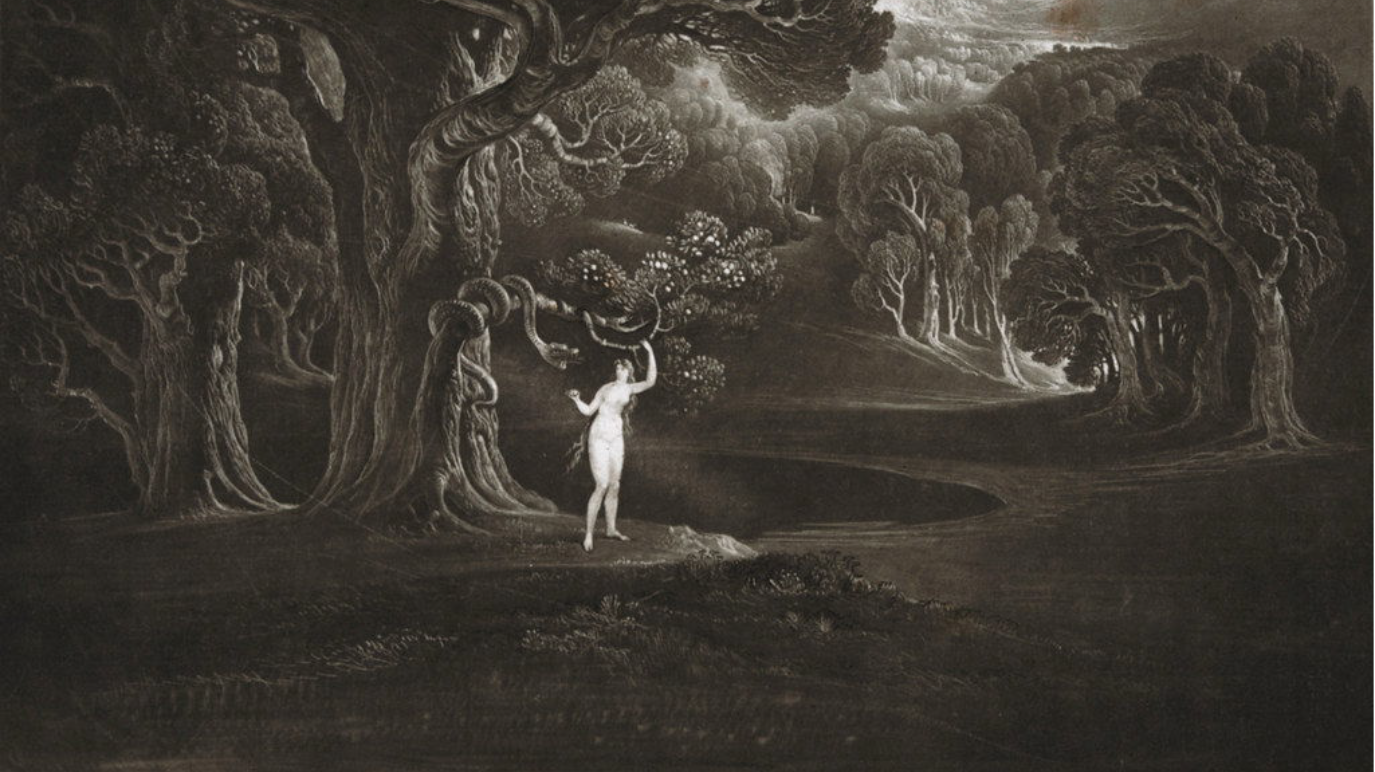
In John Milton’s Paradise Lost, prelapsarian Eve embodies an ideal form of being in which mind and body exist in fluid conversation. Eve’s mind and body are neither conveyed as opposing forces on two sides of a binary nor as a collapsed combination without difference. Rather, the two realms have a mutually beneficial partnership, similar to Eve’s own partnership with Adam before the Fall. Through Eve’s depiction, notably the image of her hair, Milton displays a vision of unity that can exist within the perfection of Eden. Eve’s flowing, uncontrollable hair is a symbol of continuous interaction between the mind and body. Her method of speech further embodies this unity, as she is the first to bring poetry into the garden, later inspiring Adam to do the same. However, her act of eating from the Tree of Knowledge—a plant which conflates intangible knowing with physical satiation—ultimately destroys the ideal which Eve once represented. The fruit suggests a dangerous fusing of body and mind into one, rather than a maintenance of their relationship as different yet related entities. Eve chooses to pursue the collapsing of binaries, facing the consequences of a restrictive world structured by regulations and separation of the body and mind. Milton models this new world on dualistic frameworks similar to those held by key thinkers of the Scientific Revolution, like Descartes, who conceptualized the body through its direct opposition to the mind as “not a thinking thing” (Descartes 55). Condemning these increasingly influential methods of thought, Milton paints them as inherently harmful, aligning them with Satan’s philosophies in the poem to further his critique. Eve represents Milton’s vision of unity between mind and body, an ideal which cannot survive in a postlapsarian world where mind and matter are positioned as alienated opposites.
When Milton first describes Adam and Eve in Book 4 of Paradise Lost, their hairstyles are used to denote both outer physical characteristics and inner qualities:
…Hyacinthin Locks
Round from his parted forelock manly hung
Clustring, but not beneath his shoulders broad:
Shee as a vail down to the slender waste
Her unadorned golden tresses wore
Disheveld, but in wanton ringlets wav’d
As the Vine curles her tendrils, which impli’d
Subjection, but requir’d with gentle sway. (PL 4.300-308)
Eve’s hair dominates much of her body in its description, running wild across her as a force “unadorned” and “Disheveld.” Her hair occupies nearly the full surface of her body, taking on an imaginative, moving shape of its own—akin to both a “vail” and a curling “Vine” at once. Despite her and Adam’s “naked Majestie” (PL 4.290), Eve’s hair functions as a veiling garment, potentially expressing modesty and “Subjection,” while also holding a vitality, beauty, and freedom tied to environmental growth. Eve’s long, flowing locks contrast with Adam’s hair, which does not extend “beneath his shoulders broad.” Milton directly describes Eve’s precious “golden tresses” in comparison to Adam’s groomed “Hyacinthin Locks,” drawing attention to Eve’s unique and personal balance between mind and body. Eve’s cascading hair extends down to her “slender waste,” moving beyond the realm of her head, linking thought and bodily action into one continuous expression or motion. In comparison, Adam’s hair is shaped and limited, reflecting his cerebral quality and his focus on reason, or “contemplation,” as his guide (PL 4.297). He is “the Head” in the garden, prioritizing rationality and assuming a leadership position (PL 9.1155). Milton uses the description of Eve’s untamed hair, and its direct difference to Adam’s in length and style, to signal Eve’s seamless union of mind and body as an ideal of rare prelapsarian harmony.
Beyond the level of appearances, Eve’s manner of speaking conveys a perfect blend of the mental and physical realms, further challenging binary divisions which Milton sees as restrictive. Eve is the first poet in the garden, turning her inward reflections into statements directed outward through speech. She presents a lyrical celebration of Adam in Book 4, filled with repetition of natural imagery and the notion of sweetness: “Sweet is the breath of morn, her rising sweet, / With charm of earliest Birds,” she sings, praising the sun’s “orient Beams” and the “sweet” coming of “Eevning milde, then silent Night” (PL 4.641-647). Eve arranges patterns of daylight and evening into a lyrical cycle that mirrors the natural rhythms of the garden, transforming her own experiences and inner meditations into euphonious art. Eve uses her elevated language to praise Adam in asserting how no beauty of nature “without [him] is sweet” (PL 4.656). Eve’s poetry comes naturally to her, and she inspires Adam to speak poetically in Book 5, guiding a form of nonphysical growth in the ever-flourishing physical space of Eden. Adam wakes Eve with a love song, stating, “My fairest, my espous’d, my latest found, / Heav’ns last best gift, my ever new delight, / Awake, the morning shines” (PL 5.18-20). He encourages Eve to arise so as not to miss “How Nature paints her colours, how the Bee / Sits on the Bloom extracting liquid sweet” (PL 5.24-25). Adam adopts Eve’s poetic strategy of using sweetness and nature’s beauty as a means to praise a lover, and he becomes more lyrical through Eve’s example. Adam’s rational voice softens to take on an imaginative mode of expression which was first demonstrated by his partner, and his success in waking Eve through this way of speaking shows her natural inclination towards the meditative and poetic.
Just as Eve’s inspirational poetry is a result of her instinctive ability to flow between mental and physical realms, her narrative of creation also reveals how internal and perceptive qualities guide her through the outer world:
…I thither went
With unexperienc’t thought, and laid me downe
On the green bank, to look into the cleer
Smooth Lake, that to me seemd another Skie.
As I bent down to look, just opposite,
A Shape within the watry gleam appeard
Bending to look on me… (PL 4.456-462)
When she first awakens as a created being, Eve looks downward into the “Smooth Lake” and does not respond with verbal mastery or categorization, but with quiet observation and intuitive reflection. She experiences the material world through internal processes and natural comparisons that build on existing knowledge, turning perception into meaning. She sees the lake as “another Skie,” exhibiting a method of observation which is comparative and internal. The nature she inhabits is a literal and figurative mirror reflecting her own consciousness back to her. Encountering her image as a “Shape within the watry gleam,” Eve does not distinguish herself from the reflected other at first. She has a meditative, nonverbal experience with creation that is focused on a mutual partnership between physical perceptions and mental awareness. Eve’s strategy of looking inward to understand the outward, or looking downwards and seeing what lies above, differs from Adam’s, who describes his creation in Book 8 with a contrasting focus on more direct and verbal observations. He looks up at “the ample Skie” and classifies it without comparing it to other aspects of his surroundings, and he then names the details of the world around him, like the “Hill, Dale, and shadie Woods, and sunnie Plaines” (PL 8.258, 262). Adam does not consider how his own emotions or experiences may affect his perceptions of the world, and he only looks beyond himself. Eve’s creation, told before Adam’s, conveys how she does not understand the world merely through external knowledge or naming. Rather, she learns about her identity and surroundings through a reciprocal exchange of physical practices and inward thoughts.
Eve’s decision to eat from the Tree of Knowledge marks the moment when her ideal unity collapses. Satan tempts her by assuming the form of a serpent, coiling like “a surging Maze” to mirror the mazy entanglement of Eve’s hair—transforming a symbol of her freedom into his instrument of temptation (PL 9.499). Eve reasons with the idea of eating the fruit, and she eventually chooses “to reach, and feed at once both Bodie and Mind” (PL 9.779). The fruit suggests a fusing of the physical and intellectual, and Eve believes it will provide the “Cure of all” (PL 9.776). In his works beyond Paradise Lost, Milton alludes to tasting and knowing as analogous, such as in the Areopagitica where he asserts, “Wholesome meats to a vitiated stomack differ little or nothing from unwholesome; and best books to a naughty mind are not unappliable to occasions of evil” (1005). However, the danger of Eve’s sin lies in the attempt to see tasting and knowing as not only similar, but as identical. Her sin implies an eradication of differences, no longer viewing the body and mind as separate sites in a mutual exchange, and instead seeing them as interchangeable realms to be fed at once. Instead of maintaining a stable partnership between body and mind—not different from Eve’s own prelapsarian partnership with Adam, who viewed her as his “sole partner” before the Fall (PL 4.411)—Eve seeks a substance that collapses all boundaries. After she eats the fruit, she recenters her universe around the tree, Heaven becomes “High and remote” (PL 9.812), and she questions the subordination she once accepted “unargu’d” (PL 4.636), asking, “For inferior who is free?” (PL 9.825). Eve enters a world of binary divisions where categories like Heaven and Earth or subordination and superiority become antonyms. Moreover, both her mind and body are punished as a result of the Fall. Not only is Eve’s “inward State of Mind, calm Region once / And full of Peace, now tost and turbulent” (PL 9.1125-1126), but her and Adam’s bodies become sources of “shame obnoxious” (PL 9.1094), with them desiring “to hide / The Parts of each from other” (PL 9.1092-3). Eve’s postlapsarian body, newly alienated from her mind, is also subject to new regulations; she is told to “expect great tidings, which perhaps / Of [her] will soon determin, or impose / New Laws to be observ’d” (PL 11.226-228), including the task of bearing children “in sorrow forth” (PL 10.195). After Eve’s sin, which seeks to merge body and mind into one, both mind and body are met with punishment and a logic of division—dismantling the unified ideal Eve once represented.
Eve’s mind-body partnership cannot be sustained after the Fall, and her fate reflects Milton’s broader critique of the binary structures shaping seventeenth-century philosophical thought on human experience. Descartes’ theory of dualism, in which the soul is “entirely distinct from any concept of the body” (Descartes 10), was “immediately and immensely influential” in Milton’s time, as noted by Stephen M. Fallon in Milton among the Philosophers (Fallon 24). Descartes defines the body and mind through their dissimilitude and opposition to one another: “We can understand no body except as divisible, but on the other hand no mind except as indivisible” (Descartes 10). Cartesian dualism is one example of how thinkers of the Scientific Revolution tried to understand human experience through rigid oppositions—a line of thought present in Milton’s early academic training as well. The Prolusions exercises delivered in college tasked Milton to think within binaries, presenting strict debates in which one side would prevail, such as “Whether Day or night is the more Excellent” (846). In “Prolusion 1,” Milton rehearses a standard method of oppositional thinking, treating day and night as contrasting categories, similar to Descartes’ definition of the mind through its absence of bodily qualities. Milton describes night as “but the passing and the death of day” (850). The academic Prolusions from Milton’s university education reflect a pedagogical environment that privileged binary thinking, aligned with the theories of Cartesian dualism. In some cases, however, such as “Prolusion 6” comparing sporting exercises to philosophical studies, Milton approaches a more combined way of seeing. Milton, like Eve, does not collapse two categories into one or see them as opposites in this debate, but aims to find a perfect flow between the two sides. He argues for the coexistence of the two fields, asserting that “no one can be a master of a fine and clever wit who has not first learnt how to behave seriously” (863). Milton’s repositioning of the argument in a way which does not isolate the two categories suggests his early commitment to experiment with a dynamic model of human experience grounded more in integration than opposition, just as prelapsarian Eve embodies a sense of balance which resists conventional divisions.
Milton deepens his critique of binary thinking in Paradise Lost through Satan’s epistemology, characterizing Cartesian thought as destructive, despite its intellectual allure. Satan’s dualistic thinking and rigid beliefs stand in contrast to Eve’s unity, conveying the dangers of reducing complexity to shallow distinctions. Milton’s unfallen Paradise is structured around mutual influence, with Eve at the center of this vision, and Milton’s “monistic conception of the relationship between body and soul is an affront to any of the available dualist conceptions” proliferating at the time (Fallon 99). Satan’s famous assertion that “the mind is its own place, and in it self / Can make a Heav’n of Hell, a Hell of Heav’n” (PL 1.254-5) is therefore an example of the type of thinking that dominates a fallen world, reflecting Descartes’ beliefs that the soul “can exist without” the body—and that the mind is therefore “its own” distant place (Descartes 55). Satan’s confidence in the mind’s separateness, as well as its fixed nature “not to be chang’d by Place or Time,” advances Milton’s overall negative critique of the logics of division and binary separations (PL 1.253). Through Satan, Milton suggests that although dualistic thinking can be sold with seductive argumentation, this line of thought is dangerous and Satanic in nature. Milton uses strategies of characterization and dialogue in the poem as a way of dressing the claims of philosophers like Descartes “in diabolic Clothing,” interrogating the legitimacy of their societal influence (Fallon 136). Ultimately, Eve’s unity no longer prevails after her Fall, and the world shifts into a mode of binary thinking which aligns with Satan’s beliefs. Eve and Satan therefore function as allegories in Paradise Lost, where Milton casts Satan as a dualist and Eve as a vision of balance in order to subtly critique certain ‘Satanic’ habits of thinking.
In Paradise Lost, Eve’s untamed, vine-like hair suggests a continuous interaction between her body and mind. Her natural ability to combine inward feeling with outward experience presents an ideal form of unity, and she holds this balance from the moment she is created until her ultimate Fall. Milton cautions against the collapsing of distinct categories into one, as seen through Eve’s sin, where her attempt to merge mind and body into a single substance destroys the harmony she once embodied. Milton’s depiction of a fallen world then presents another dangerous mode of thinking in which categories like body and mind do not exist in dialogue, but are defined through their opposition to one another. This new, divided world, rooted in strict comparisons as opposed to nuance, aligns with Satan’s views as well as the ideologies of Cartesian dualism and Prolusion-style exercises of seventeenth-century academia. Milton’s ideal Paradise does not aim to erase differences or enforce binary comparisons, and he critiques those who fall into these habits. His vision of perfection relies on reciprocal relationships between entities, similar to Adam and Eve’s mutually beneficial partnership before the Fall, in which they originally embraced their differences as part of a balanced order.
Works Cited
Descartes, René. Meditations on First Philosophy: With Selections from the Objections and Replies. Translated by Michael Moriarty, Oxford University Press, 2008.
Fallon, Stephen M. Milton among the Philosophers: Poetry and Materialism in Seventeenth-Century England. Cornell University Press, 2018.
Milton, John. “Areopagitica.” The Riverside Milton, edited by Roy Flannagan, Houghton
Mifflin, 1998, pp. 987-1025.
—. Paradise Lost. Edited by Barbara K. Lewalski, Blackwell Publishing, 2007.
—. “Prolusions.” The Riverside Milton. Edited by Roy Flannagan, Houghton Mifflin,
1998, pp. 845-873.